
Quick Summary
This guide explains how aging plumbing risers and steam heating failures threaten historic prewar co-ops, establishing the critical need for technical water damage restoration in Upper West Side properties. Wade's Restoration delivers premier Manhattan emergency response with rapid 45-minute dispatch, using targeted structural drying and thermal mapping to save original plaster and hardwood flooring without unnecessary demolition. Property owners can immediately call the 24/7 emergency dispatch line to schedule a fast response, obtain a free visual inspection, and receive a comprehensive written scope of work for full mitigation and reconstruction.
Water Damage Restoration in Upper West Side
If your apartment, brownstone, or commercial property is flooded, Wade’s Restoration provides technical services to dry out the structure, protect your finishes, and prevent secondary mold growth. While New York City hazard profiles and neighborhood climate reports show that the Upper West Side has lower coastal flood risk than both the Manhattan and citywide averages, local properties face constant internal plumbing hazards. Between 1920s steam heating systems, aging cast-iron risers, and high-pressure supply line breaks, sudden water events can spread through multi-story buildings quickly.[1]
Our focus is on preservation over demolition where feasible. Instead of immediately tearing down plaster or removing prewar hardwood floors, targeted structural drying can often help stabilize architectural materials and minimize co-op alteration complications. Documentation is provided for property owners navigating insurance processes. Contact our service line to request response options and an on-site visual assessment with a written scope of work. See also Water Damage Restoration in Lower Manhattan | Call Now-10% Off | Same-Day Service | Free Estimate.
Emergency Response for Prewar Apartments and High-Rises
When water penetrates a ceiling or spreads across flooring, prompt containment is critical to help stop moisture from migrating into lower units, affecting building electrical systems, or saturating subfloors.[3]
According to NYC Open Data building datasets for the Upper West Side and Manhattan Valley, local housing stock contains a dense mix of prewar co-ops, condominiums, and historic townhouses. These structures frequently feature plaster-and-lath assemblies and dense hardwood subfloors that can trap moisture behind baseboards and inside service chases. Emergency restoration practices at Wade’s Restoration utilize tools such as moisture meters, thermal imaging equipment, and water extractors to evaluate moisture migration and stabilize the affected areas.[5]
What Steps Are Involved in Water Extraction and Structural Drying?
Drying a multi-family building or historic property typically follows a systematic approach designed to address moisture efficiently.
1. Thermal Mapping and Bulk Water Extraction
Technicians use moisture meters and thermal imaging to help identify moisture spread behind walls, under floors, and through vertical chases. High-capacity extraction units remove standing water resulting from pipe breaks, radiator issues, or appliance overflows.[2]
2. Controlled Drying for Hardwood Floors and Plaster
To reduce unnecessary demolition and related building board reviews or alteration requirements, specialized drying techniques may be used. Commercial dehumidifiers and targeted floor drying systems help extract moisture from wood and subfloor assemblies to minimize warping and cupping when conditions permit.
3. Cavity Drying and Moisture Monitoring
Airflow can be directed into accessible wall cavities and service chases to address internal structural framing. Technicians take periodic moisture and psychrometric readings to track drying progress until moisture levels return to acceptable baseline standards.
What Does Water Damage Restoration Cost in the Upper West Side?
Need water damage restoration in Upper West Side?
We’re available now - call for a fast, free estimate.
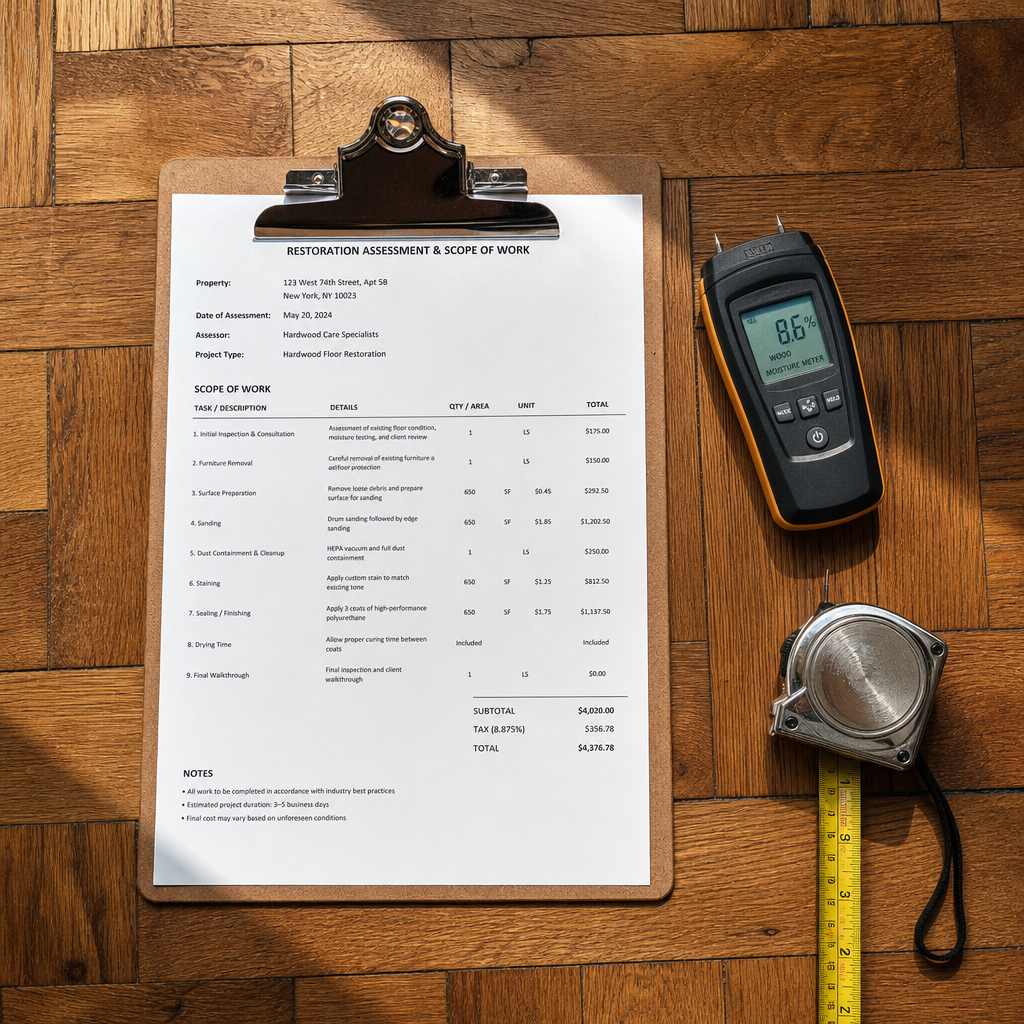
Water damage restoration costs in Manhattan vary widely depending on the extent of water intrusion, structural design, and specific project requirements; standardized pricing was not independently verified. Final costs typically depend on several key factors:
- Water Category: Clean water from supply lines typically requires fewer containment measures than gray water from appliances or black water from sewage and waste lines, which necessitates specialized sanitation protocols.
- Material Density: Older plaster-and-lath assemblies and multi-layered subfloors generally require longer drying cycles and specialized equipment compared to standard modern drywall.
- Scope of Restoration: Non-invasive drying, when viable, focuses on preserving existing materials, whereas extensive structural damage or contamination requires demolition, debris removal, and rebuild services.
| Restoration Approach | Material Preservation | Co-op / Building Impact | Documentation Considerations |
|---|---|---|---|
| Targeted Structural Drying | Higher potential to salvage sound plaster, trim, and flooring | May minimize the scope of formal alteration agreements | Supported by periodic moisture logs and drying records |
| Material Removal & Demolition | Involves removal of non-salvageable materials | May require formal architectural review or building approvals | Requires detailed documentation of damaged building components |
| Delayed Mitigation | Increases risk of permanent rot, mold, and secondary loss | Higher potential for building complaints and spread to adjacent units | May complicate insurance claims if maintenance was neglected |
How Restoration Specialists Prevent Mold Growth and Save Historic Materials
Mold spores can begin to germinate quickly in damp, enclosed environments. In prewar buildings, steam heat and uninsulated radiator risers can introduce elevated humidity into wall cavities, creating favorable conditions for microbial growth following a water leak.[4]
To control the spread of particulates and spores during mitigation, Wade’s Restoration deploys containment barriers and HEPA air filtration units to manage air movement within the work area. Antimicrobial treatments may be applied to accessible framing and structural components where appropriate to inhibit microbial development during the drying process.
| Building Material | Restoration Consideration | When Replacement Is Typically Evaluated |
|---|---|---|
| Plaster and Wood Lath | Low-grain dehumidification and cavity airflow | Severe structural degradation or complete detachment of plaster keys |
| Hardwood and Parquet Flooring | Specialized drying mats and controlled dehumidification | Irreversible cupping, buckling, or severe subfloor delamination |
| Baseboards and Architectural Molding | Careful inspection, localized drying, or temporary removal | Permanent structural rot or extensive physical breakage |
Frequently Asked Questions About Upper West Side Water Damage Restoration
How quickly can a water damage restoration team arrive on the Upper West Side?
Arrival times vary depending on building access, traffic, and specific location, but restoration providers generally offer 24/7 dispatch to initiate mitigation as promptly as possible. Timely response helps contain leaks, prevent water migration to adjacent units, and mitigate damage to finishes.
Does homeowner or renter insurance cover water damage restoration in NYC?
Coverage depends on the specific terms of each individual policy. Property insurance policies commonly provide coverage for sudden and accidental water damage, such as a sudden pipe burst or appliance failure, while standard policies typically exclude damage resulting from gradual leaks, maintenance neglect, or external flood events. Policyholders should consult their insurer and provide thorough drying logs and photo documentation.
How much does water damage restoration typically cost in Manhattan?
Costs vary substantially based on the square footage affected, the source and category of water, the time required for structural drying, and whether building materials can be saved or must be removed. Because pricing is specific to each property and was not independently verified as a fixed scale, on-site evaluations are necessary to establish an accurate scope of work and estimate.
What should I do immediately after discovering a leak or burst pipe in my apartment?
First, turn off the water source immediately if an individual fixture valve is accessible, or notify building management to shut down the main riser. Turn off power at the breaker to affected rooms if water is near electrical outlets or fixtures. Move valuable personal belongings away from standing water, document the scene with photos or video, and contact a professional mitigation service.
How do restoration specialists prevent mold growth after water damage?
Specialists like Wade’s Restoration mitigate mold risk by rapidly reducing ambient and structural moisture using commercial dehumidifiers and air movers. Technicians may also establish containment with HEPA air filtration and apply appropriate antimicrobial agents to affected framing and surfaces to inhibit microbial growth.
What steps are involved in the water extraction and drying process?
The process generally involves an initial moisture evaluation and mapping, extraction of standing water, installation of commercial dehumidifiers and air movers, periodic monitoring of moisture levels, and application of sanitizing agents when appropriate until drying goals are achieved.
If your property has experienced water damage, contact Wade’s Restoration to discuss emergency mitigation, structural drying processes, and on-site assessment options.
Need water damage restoration in Upper West Side?
We’re available now - call for a fast, free estimate.
Sources
- Climate and Health in Upper West Side – a816-dohbesp.nyc.gov (2024)
- Flood Risk in NYC Information Brief – nyc.gov (2015)
- Ten Years After Sandy: Barriers to Resilience – comptroller.nyc.gov (2012)
- Climate – nyc.gov (2015)
- Ten Years After Sandy – New York City Comptroller – NYC.gov – comptroller.nyc.gov
Related reading: Water Damage Restoration in Union City – 10% Off & Free Estimate – Same-Day Service
Related reading: Water Damage Restoration in Hoboken – 10% Off & Free Estimate – Same-Day Service
Related reading: Water Damage Restoration in Astoria – 10% Off & Free Estimate – Same-Day Service
Water Damage Restoration in Nearby Cities
We also serve the communities around Upper West Side:
- Water Damage Restoration in Financial District
- Water Damage Restoration in Glendale
- Water Damage Restoration in Long Island City
- Water Damage Restoration in Midtown Manhattan
- Water Damage Restoration in Midtown West
- Water Damage Restoration in North Bergen
- Water Damage Restoration in Secaucus
Frequently Asked Questions
How does Wade's Restoration coordinate with Upper West Side co-op boards and property managers during a water leak?
Wade's Restoration works directly with building supers and co-op boards, providing formal moisture logs and non-invasive drying protocols to prevent unauthorized demolition and avoid alteration disputes. Our emergency team dispatches in 45 minutes to contain high-rise riser leaks and protect neighboring units from secondary damage.
What happens if historic plaster or prewar hardwood floors cannot be saved through structural drying?
When building materials suffer irreversible subfloor delamination or structural breakdown, Wade's Restoration seamlessly transitions from emergency extraction to full reconstruction. Our team handles every phase of the rebuild, ensuring your prewar architectural details are faithfully restored to pre-loss condition.
How do I obtain a written scope of work for my insurance claim after a leak?
Call Wade's Restoration on our 24/7 dispatch line to book an immediate on-site arrival and free visual inspection. Our technicians compile detailed thermal imaging data, moisture readings, and drying logs into a comprehensive written scope of work ready for your insurance adjuster.
About the author
 |
Christopher Vance Christopher Vance brings over 12 years of hands-on experience in emergency property restoration to his writing. Holding an IICRC certification in Water Damage Restoration and a degree in Environmental Science from Rutgers University, he specializes in creating actionable, expert guides for property owners facing critical damage. His work focuses on providing clear, practical advice to help Lower Manhattan residents navigate the complexities of water and flood recovery. |
Water damage, flood, or mold emergency?
We’re available now - call for a fast, free estimate.
Call Now - Free Estimate