
Quick Summary
Managing emergency water damage restoration in Financial District high-rises, prewar lofts, and sub-grade commercial spaces requires rapid containment to prevent water migration down vertical utility chases and curb structural loss. Wade's Restoration provides hyper-local 45-minute emergency dispatch across Lower Manhattan, using specialized elevator-compatible extractors and preservation-first drying systems to salvage historic building materials without disruptive demolition. Readers will learn logistical restoration steps and insurance navigation protocols, allowing them to call Wade's Restoration 24/7 for fast emergency extraction or request a free visual inspection with an itemized scope of work.
Water Damage Restoration in Financial District: Fast Response & Preservation
When dealing with water damage in the Financial District, building logistics and prompt action matter just as much as extraction equipment. Wade’s Restoration dispatches certified in-house technicians across Lower Manhattan to manage everything from sudden riser breaks in high-rise towers to groundwater intrusion in historic commercial basements. Our services cover emergency water removal, structural drying, and complete repairs, with isolated clean-water incidents starting around $1,500 and larger multi-unit restorations billed directly to insurance carriers.
In Lower Manhattan, a pressurized riser leak on an upper floor or a groundwater surge below grade can flood multiple units in minutes. Instead of routing calls to remote call centers or passing jobs to third-party subcontractors, our local team provides direct technician dispatch. We bring specialized high-rise extraction systems up service elevators, assess hidden moisture with thermal imaging, and document all drying progress through our Claim Clarity Program. Contact our local dispatch line 24/7 for emergency service or to arrange an on-site visual inspection and written scope of work. See also Water Damage Restoration in Lower Manhattan | Call Now-10% Off | Same-Day Service | Free Estimate.
Quick answer
Quick answer in brief: Water damage restoration in Financial District properties requires rapid containment to control high-rise riser bursts, steam pipe moisture, and sub-grade flooding. Certified technicians remove standing water with portable high-lift extractors, install desiccant dehumidifiers, dry architectural elements like historic hardwood in place, and record daily moisture logs to stop mold formation within 24 to 48 hours.
Restoring water-damaged properties in Lower Manhattan requires fast containment to stop water from migrating down vertical utility chases into lower apartments and commercial suites. Wade’s Restoration prioritizes structural drying and material preservation, helping property owners avoid costly, unneeded demolition that disrupts tenants and triggers building alteration disputes.
According to standard guidelines from the Institute of Inspection, Cleaning and Restoration Certification (IICRC), structural drying should begin within 24 to 48 hours to stop microbial growth and protect building materials. Managing water emergencies in high-density downtown properties follows three essential steps:
- Rapid Containment: Transporting portable high-lift extractors via service elevators to halt water migration from vertical pipe breaks immediately.
- Preservation-First Drying: Deploying desiccant dehumidifiers and negative-pressure floor mats to dry historic plaster, prewar hardwoods, and wall assemblies without tear-outs.
- Insurance & Co-op Documentation: Maintaining digital moisture records and psychrometric data to satisfy commercial insurance adjusters and co-op alteration boards.
How Do Multi-Floor Riser Leaks and Water Table Flooding Damage Lower Manhattan Buildings?
Need water damage restoration in Financial District?
We’re available now - call for a fast, free estimate.
Multi-floor riser ruptures and high water tables damage Financial District properties by pushing pressurized water down utility chases and driving moisture up through foundation slabs. This saturation damages plaster, warps hardwood flooring, and threatens electrical vaults, requiring quick extraction to protect the structure.
Drywall, Ceilings, and Multi-Level Water Cascades
When a vertical supply pipe fails near the top of a high-rise, water drains through electrical conduits, elevator shafts, and shared utility chases across several floors. Tearing open walls immediately can violate co-op alteration bylaws and may trigger mandatory asbestos testing in pre-1980 buildings. Instead of gutting plaster ceilings and drywall right away, technicians use infrared cameras to locate moisture paths and inject heated dry air into wall cavities. IICRC field data shows that structural framing dried within 48 hours retains the vast majority of its load-bearing strength. This targeted drying stabilizes the vertical stack while keeping disruption to neighboring units minimal.
Preserving Prewar Hardwood Floors vs. Demolition
Original parquet, herringbone, and tongue-and-groove oak floors are valuable features in Downtown lofts. Wade’s Restoration applies negative-pressure floor drying mats to draw water directly out of the subfloor rather than immediately tearing out cupped planks.
| Restoration Parameter | Preservation-First In-Place Drying | Standard Demolition & Tear-Out |
|---|---|---|
| Co-op Board Approval | Straightforward process; non-invasive setup | Requires formal architectural reviews and work permits |
| Historic Asset Value | Saves original prewar hardwood and plaster | Replaces historic flooring with modern, non-matching materials |
| Displacement Time | 2 to 4 days of continuous mat drying | Weeks of demolition, debris carting, and rebuilding |
Below-Water-Table Basements and Sub-Grade Infiltration
Properties along Water Street and near Battery Park City sit over historical landfill near tidal water tables. Storm surges and broken municipal mains exert hydrostatic pressure against foundations, forcing water and Category 3 waste through floor drains and slab joints. Remediating these areas requires high-volume submersible pumps, antimicrobial sanitation, and continuous desiccant dehumidification to protect mechanical equipment and utility vaults from long-term moisture damage.
What Specialized Equipment Is Required for High-Rise and Loft Water Extraction?
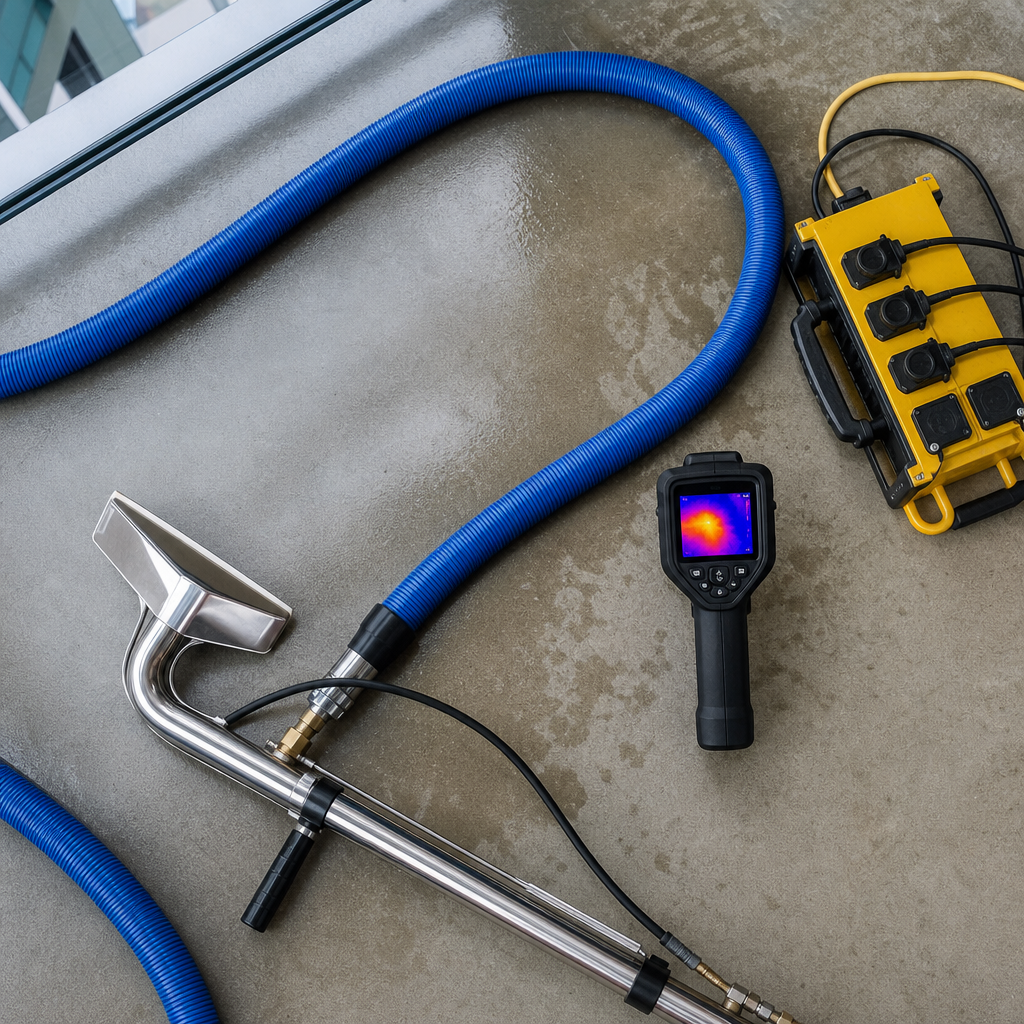
High-rise and loft water extraction depends on portable, high-performance equipment that fits inside standard service elevators, paired with industrial desiccant dehumidifiers and infrared diagnostic tools. These systems extract bulk water from concrete subfloors and dry deep cavities without requiring wall removal.
High-Volume Extraction and Vertical Cavity Drying
Standard truck-mounted extractors parked on city streets cannot reach upper floors in high-rise lofts or sub-grade mechanical rooms. Effective restoration in the Financial District relies on modular, high-CFM extraction machines that fit standard freight elevators while delivering heavy-duty vacuum lift. To counteract humid coastal air and steam heating moisture, crews deploy desiccant and low-grain refrigerant (LGR) dehumidifiers. Desiccants introduce dry, low-humidity air into sealed wall cavities, pulling trapped moisture out of masonry and dense plaster without disturbing the building structure.
| Building Challenge | Specialized Equipment | Structural Benefit |
|---|---|---|
| Freight elevator weight and size limits | Modular high-lift extractors | Removes standing water on upper floors without running long hose lines down public stairwells. |
| Dense masonry and plaster walls | Desiccant dehumidifiers | Pulls moisture from deep within structural assemblies using low vapor pressure. |
| Hidden riser leaks in utility chases | Infrared thermal cameras | Identifies water travel behind walls without opening unnecessary inspection holes. |
Air Filtration and Mold Prevention
The Environmental Protection Agency notes that mold spores can colonize damp building materials within 24 to 48 hours of exposure. Managing this risk in multi-unit buildings with shared ventilation systems requires negative-air scrubbers equipped with HEPA filtration, which trap 99.97% of airborne particles down to 0.3 microns. Technicians trace moisture with thermal imaging and treat exposed framing with EPA-registered botanical antimicrobials. Running this equipment stabilizes indoor air quality and stops moisture and odors from migrating into neighboring units.
What Does Water Damage Restoration Cost in Financial District?
Need water damage restoration in Financial District?
We’re available now - call for a fast, free estimate.
Restoring water damage in Financial District buildings generally ranges from $1,500 for minor, single-room clean-water leaks up to $15,000 or more for multi-floor pipe breaks that require extensive structural drying and material replacement. Final costs depend on the water source, total square footage, and whether finishes can be dried in place.
Typical Restoration Cost Breakdown
Pricing reflects the logistical considerations of Lower Manhattan high-rises and prewar lofts, where water quickly travels across shared utility lines and multi-layer flooring.
| Feature | Clean Water (Cat 1) | Grey / Sump (Cat 2) | Sewage / Multi-Floor (Cat 3) |
|---|---|---|---|
| Typical Cost Range | $1,500 – $3,800 | $3,000 – $7,500 | $7,000 – $20,000+ |
| Extraction & Drying Time | 24 to 48 hours | 3 to 5 days | 5 to 10 days |
| Controlled Demolition | Rare or minimal | Baseboards & lower insulation | Extensive drywall & subfloor removal |
| Antimicrobial Treatment | Optional | Required | Mandatory throughout |
Navigating Insurance Claims and Co-op Bylaws
Data from the Insurance Information Institute shows that water damage and freezing pipes represent nearly a quarter of all property insurance losses. In Lower Manhattan co-ops and condominiums, strict alteration rules and questions over shared-riser liability often complicate claim reviews. Unplanned demolition can breach house rules and increase out-of-pocket costs.
Wade’s Restoration assists property owners through our Claim Clarity Program. When our technicians arrive on site, we perform a detailed visual inspection and map all affected areas. We submit daily moisture logs, psychrometric readings, and thermal photos directly to your insurance adjuster, ensuring the claim stays on track for both basement water extraction and multi-level high-rise drying. Our in-house team handles the job from the initial water extraction through final structural repairs.
Frequently Asked Questions About Financial District Water Restoration
Managing water damage in Lower Manhattan requires working within compact utility chases, adhering to building bylaws, and protecting architectural finishes under tight timelines. Fast professional mitigation stops pipe leaks and foundation seepage before moisture damages structural framing or spreads into adjacent units.
How much does water damage restoration cost in Financial District?
Costs typically start between $150 and $500 for moisture mapping and initial assessment, and range from $3,000 to $15,000 or more for multi-room extraction, structural drying, and repairs. Total pricing depends on the water category, elevator access, and whether original materials can be saved in place.
How quickly can an emergency water extraction crew respond in the Financial District?
Wade’s Restoration provides 45-minute on-site emergency dispatch across Lower Manhattan. Our 24/7 dispatch connects you directly with certified in-house technicians who arrive prepared with portable extraction and drying gear designed for high-rise buildings.
Does property insurance cover water damage restoration in Financial District buildings?
Yes, standard commercial policies, homeowner insurance, and co-op master policies generally cover sudden, accidental pipe bursts and riser failures. The Insurance Information Institute reports that water damage accounts for roughly one in five commercial property claims annually. Through our Claim Clarity Program, we supply carrier-ready moisture data and scope documentation from day one.
What are the immediate steps to take after a burst pipe in an office high-rise?
First, alert building management and shut off the main water isolation valve for that riser stack. Next, turn off electricity to flooded areas at the breaker panel to prevent electrical hazards. Move valuable equipment and records off the floor, and call a certified restoration contractor to begin bulk extraction and set up containment before water enters elevator banks or electrical chases.
How do restoration contractors prevent mold growth following water intrusion?
Preventing mold requires applying EPA-registered antimicrobials, setting up negative-air HEPA containment, and running industrial desiccant dehumidifiers within the first 24 to 48 hours. Contact Wade’s Restoration 24/7 for emergency dispatch or to schedule a free visual inspection with an itemized scope of work.
Need water damage restoration in Financial District?
We’re available now - call for a fast, free estimate.
Related reading: Water Damage Restoration in Astoria – 10% Off & Free Estimate – Same-Day Service
Frequently Asked Questions
How do restoration teams navigate co-op board bylaws and pre-1980 asbestos rules during emergency water damage?
In prewar Financial District buildings, invasive demolition can trigger mandatory asbestos testing and complex co-op architectural reviews. Wade's Restoration uses non-invasive cavity drying and negative-pressure mat systems to dry original plaster and hardwoods in place, preventing regulatory delays and preserving historic structural assets.
What is the remediation protocol for sub-grade commercial basements flooded by groundwater surges?
Sub-grade spaces near Lower Manhattan's waterfront often face Category 3 blackwater contamination and hydrostatic foundation pressure. Wade's Restoration deploys high-volume submersible pumps, applies EPA-registered botanical antimicrobials, and operates continuous desiccant dehumidifiers to protect electrical vaults and mechanical infrastructure from long-term moisture decay.
How is multi-unit insurance handled when a high-rise riser leak damages multiple floors?
Multi-floor riser leaks require coordinated documentation across tenant policies, landlord master insurance, and co-op management. Through the Claim Clarity Program, Wade's Restoration provides itemized visual scopes, thermal imagery, and daily psychrometric data directly to adjusters, ensuring seamless claim processing across all affected commercial and residential units.
About the author
 |
Christopher Vance Christopher Vance brings over 12 years of hands-on experience in emergency property restoration to his writing. Holding an IICRC certification in Water Damage Restoration and a degree in Environmental Science from Rutgers University, he specializes in creating actionable, expert guides for property owners facing critical damage. His work focuses on providing clear, practical advice to help Lower Manhattan residents navigate the complexities of water and flood recovery. |
Water damage, flood, or mold emergency?
We’re available now - call for a fast, free estimate.
Call Now - Free Estimate