
Last updated August 26, 2026
Free visual inspection and a written scope of work before any mitigation begins - photos, moisture readings, and drying logs go in your claim file
The scope we write is the scope we bill. Anything new gets shown to you, in writing, before we touch it.

 Before
 After
After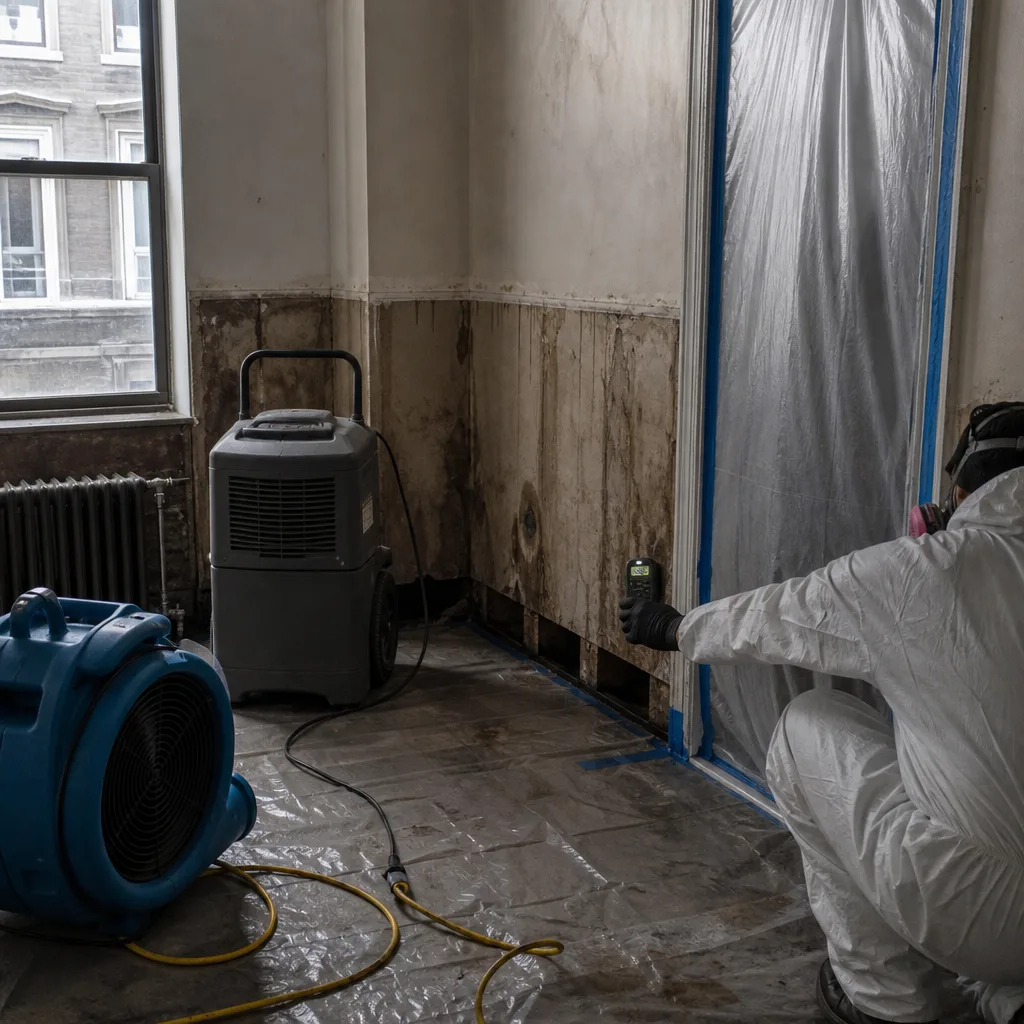 Before
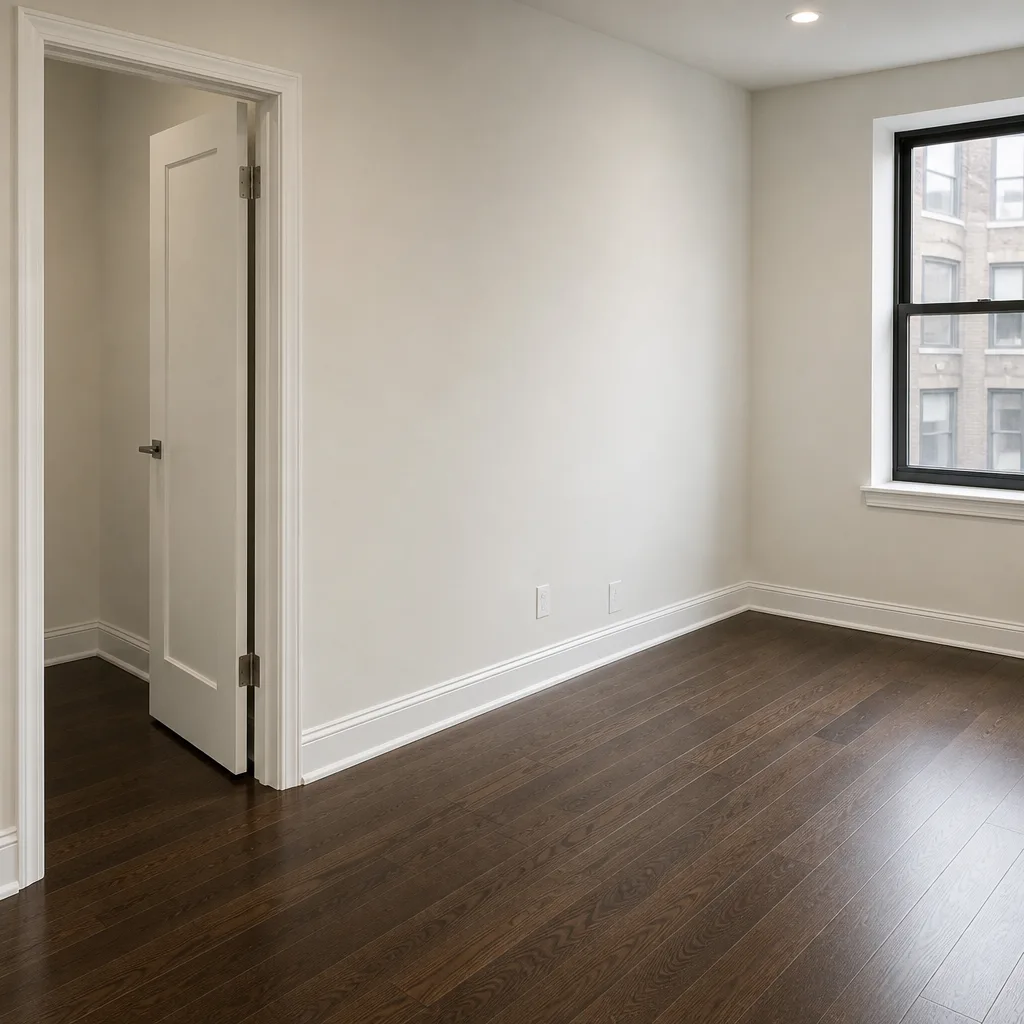 After
After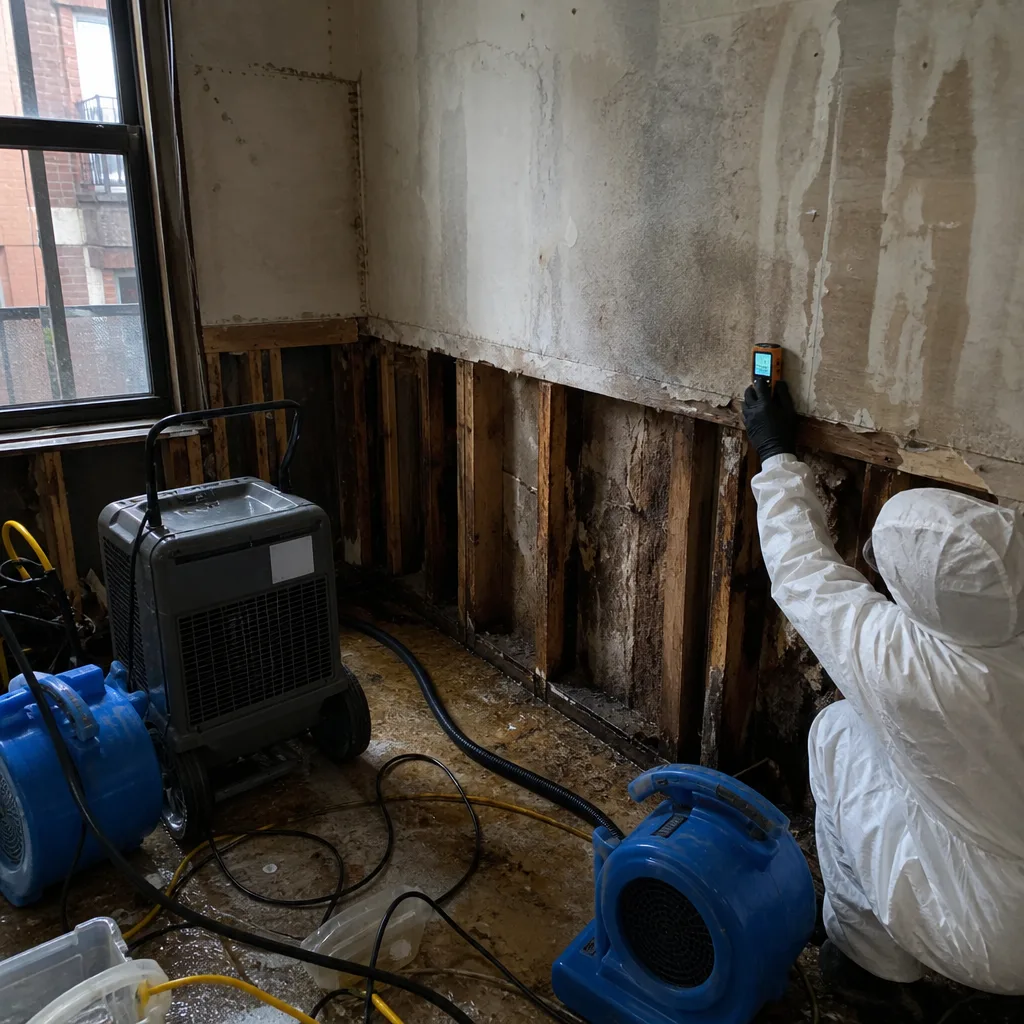 Before
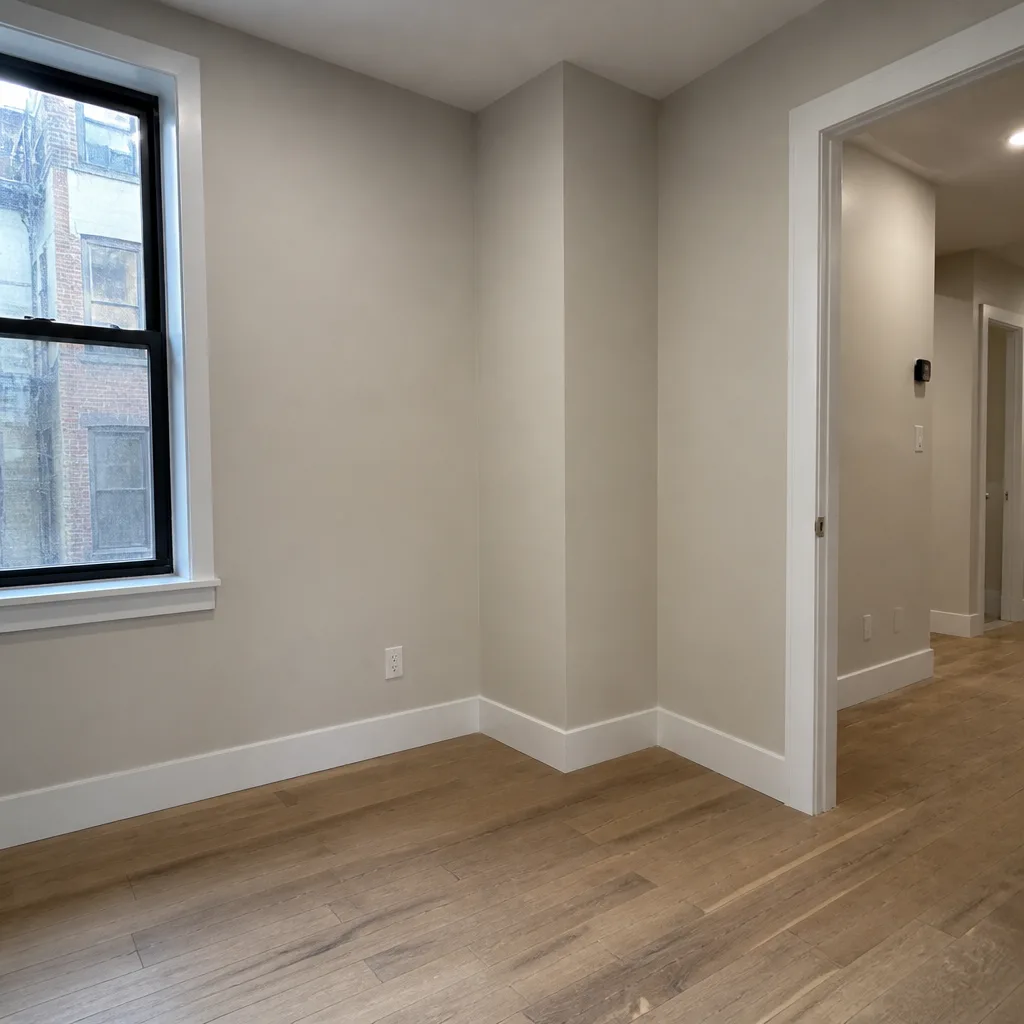 After
AfterDIY vs Professional Damage Restoration: The Lower Manhattan Homeowner’s Decision Guide
Here’s the thing nobody tells you when you’re standing in two inches of water at 2 a.m. in a Lower Manhattan apartment: the hardest part isn’t the drying. It’s figuring out what your building, your insurance company, and New York State law will let you do without making everything worse. We’ve watched a Tribeca condo owner void a $40,000 claim because he tore out wet drywall before the adjuster photographed it. We’ve seen a co-op shareholder in Battery Park City get hit with a lease violation for running commercial dehumidifiers without board approval. This guide draws the actual line between what you can handle yourself and what requires a professional, not by competence but by contract, code, and coverage. For more on finding the right help, see our How to Hire a Damage Restoration Contractor in Lower Manhattan: A Step-by-Step Guide. By the end, you’ll know exactly which side of that line you’re standing on.
Quick Answer
In Lower Manhattan, DIY water damage restoration is generally only safe and legal for small, clean-water spills under about 10 square feet that you can fully dry within 24 to 48 hours. Anything involving Category 2 or Category 3 water, electrical wiring, structural materials, mold growth, or damage that touches a neighboring unit is a job for professionals, and attempting it yourself can void your insurance coverage and violate your co-op bylaws or lease. Call Wade’s Restoration at (607) 350-1550 for a free estimate and an honest answer about which category your damage falls into.
Table of Contents
- The Legal Line: What Your Lease, Co-op Bylaws, and Insurance Actually Say
- What You Can Legitimately Do in the First 24 Hours
- Water Categories: Why Gray and Black Water Are Never DIY
- The Hidden Cost Math: Why Cheap Drying Creates Expensive Mold
- Equipment Reality: What DIY Drying Actually Requires in a Lower Manhattan Apartment
- Fire and Smoke Damage: Where DIY Attempts Go Wrong Fast
- When Wade Will Tell You to Handle It Yourself
- Common Mistakes to Avoid
- When to Call a Professional
- Frequently Asked Questions
- The Bottom Line
The Legal Line: What Your Lease, Co-op Bylaws, and Insurance Actually Say
New York City co-op boards have proprietary leases that define “alterations” in language broad enough to include significant drying and demolition work. A unit owner who rips out water-damaged drywall without board approval may be in breach of their proprietary lease before the damage is even remediated. We’ve walked into buildings in Lower Manhattan where the board required a licensed contractor’s insurance certificate just to run a dehumidifier in a hallway. Condo associations in Battery Park City and the Financial District often have similar rules written into their bylaws. Rental tenants face another layer: your lease almost certainly prohibits unpermitted structural work, and your landlord’s policy won’t cover damage you caused while attempting a repair.
Insurance adds a second legal constraint. Most homeowners and condo policies include language requiring the policyholder to “mitigate further damage” but also to “preserve evidence for inspection.” Those two clauses pull in opposite directions. The first one pushes you to start drying immediately. The second one says wait for the adjuster to document everything. In Lower Manhattan, where adjusters are often booked out 48 to 72 hours after a major storm or pipe break, that tension gets acute. We’ve seen claims denied because a homeowner removed water-damaged materials before the adjuster could photograph them. The insurance company’s position was simple: no photos, no proof, no payment. Wade has spent 18 years navigating exactly this conflict for New Yorkers, and the sequence matters more than most people realize. You document first, then you dry.
Water damage restoration in Lower Manhattan involves navigating rules that suburban homeowners never encounter. A single-family house in Putnam County doesn’t have a co-op board or a downstairs neighbor whose ceiling is your floor. In a 40-story tower near Wall Street, every decision you make about water affects people above, below, and beside you. That’s why the DIY math is fundamentally different here than in the rest of the state.
What You Can Legitimately Do in the First 24 Hours
The first day after water damage is when you have real agency. The actions you take in that window can save thousands of dollars or torpedo your claim. Here’s what a homeowner or tenant in Lower Manhattan can and should do immediately, followed by what you should not do no matter how tempted you are. Our Water Damage Restoration Maintenance Checklist for Lower Manhattan Homeowners can help you stay organized during those critical first hours.
Do This First
- Shut off the water source. If it’s a burst pipe or failed appliance connection, find the shutoff valve. In older Lower Manhattan buildings, individual unit shutoffs may be behind an access panel in the bathroom or kitchen. If you can’t find it, call your super or building management immediately.
- Kill the power to affected rooms. Water and electricity don’t mix. If your breaker box is accessible and dry, flip the breakers for the affected area. If the panel is wet or you have to stand in water to reach it, don’t touch it. Call Con Edison.
- Photograph everything before you move anything. Use your phone. Shoot wide shots of the whole room, then close-ups of every affected surface. Photograph the water source, the standing water, the water line on walls and baseboards. This documentation is what your insurance claim will stand or fall on.
- Move dry belongings out of the wet zone. Furniture, rugs, electronics, books. Get them to a dry area. Don’t carry dripping items across a dry floor, you’ll spread the problem.
- Call your insurance company and report the loss. Do this the same day. Get a claim number. Ask when the adjuster will arrive. If they say five days out, ask for permission in writing to begin emergency mitigation. Some carriers will authorize a water mitigation company over the phone.
- Call Wade at (607) 350-1550. One call brings him out. He answers his own phone, and he’ll tell you honestly whether you need a crew or whether this is a rent-an-air-mover situation you can handle yourself. No charge for that conversation, and no charge for the trip if you’re in his county.
Do Not Do This
- Don’t tear out drywall, baseboards, or flooring before the adjuster sees it. Once it’s in a trash bag on the curb, it’s gone, and so is your proof. If you absolutely must remove material because it’s actively spreading water, photograph it first from every angle, keep a sample piece, and document the moisture readings that justified removal.
- Don’t use a household vacuum to remove water. A standard shop vac will handle small puddles, but a regular household vacuum is a fire hazard. More importantly, neither one removes water that has wicked into drywall, subfloor, or wall cavities, which is where the real damage lives.
- Don’t run extension cords across wet floors. This seems obvious, but at 3 a.m. with water rising, people make bad decisions. Unplugged or not, it’s a hazard.
- Don’t open walls to “let them dry.” Wall cavities don’t dry by themselves in Lower Manhattan humidity. They grow mold. And if you’ve opened the wall without board approval in a co-op, you’ve now got two problems.
Water Categories: Why Gray and Black Water Are Never DIY
The IICRC (Institute of Inspection, Cleaning and Restoration Certification) sorts water damage into three categories. Understanding these categories is the single fastest way to know whether you’re in DIY territory or professional territory. The category isn’t about how the water looks. It’s about what’s in it.
Category 1: Clean Water
Clean water comes from a supply line, a faucet left running, a broken pipe carrying potable water, or rainwater that hasn’t touched anything contaminated. If you catch it fast, within 24 to 48 hours, and the affected area is small, a capable homeowner with the right equipment can often handle this. The key word is fast. Clean water becomes Category 2 water in about 48 hours as it sits and collects bacteria.
Category 2: Gray Water
Gray water contains significant contamination. Think washing machine overflow, dishwasher discharge, toilet overflow with urine but no feces, or clean water that’s been sitting for more than 48 hours. Gray water can carry bacteria, viruses, and fungi. It’s not DIY territory. You need professional extraction, antimicrobial treatment, and drying with commercial equipment. The health risk is real, and the drying standards are higher.
Category 3: Black Water
Black water is grossly contaminated. Sewage backups, toilet overflow with feces, floodwater from the street or the East River, water that has been through a flooded crawl space. Black water contains pathogens that cause serious illness, including hepatitis, tetanus, and gastrointestinal infections. No homeowner should ever attempt to handle Category 3 water without full PPE and professional training. In Lower Manhattan, where old combined sewer systems back up during heavy rain, sewage in basements and ground-floor units is a recurring problem. Mold remediation in Lower Manhattan is often the follow-up cousin to Category 3 events, because black water leaves contamination behind long after the visible water is gone.
Here’s the honest truth Wade gives every caller who describes a sewage backup: “I’m not going to tell you this is a Mr. Clean and a mop situation. It’s not. And I’m not going to pretend it’s safe when it isn’t. You need a professional with the right equipment and the right PPE. That’s me, but even if you call someone else, call someone who knows what they’re doing.”
The Hidden Cost Math: Why Cheap Drying Creates Expensive Mold
Let’s talk numbers, because this is where DIY water damage restoration in New York City goes quietly wrong. A professional water mitigation job for a moderate pipe break in a Lower Manhattan apartment (let’s say a burst supply line that soaked 200 square feet of hardwood and drywall) typically costs $3,000 to $6,000. That covers extraction, equipment setup, daily monitoring, moisture readings, and the drying log. Add repairs on top, and you’re looking at $8,000 to $15,000 total.
Now let’s look at the DIY path. A homeowner rents two air movers and a dehumidifier from a local rental shop for $200 a week. They run them for three days with a fan pointed at the wall. The surface feels dry. They put the furniture back. Six months later, they notice a musty smell near the baseboard. A year later, the baseboard is discolored, and there’s a patch of black mold behind the dresser. Now they need mold remediation, which in Lower Manhattan runs $4,000 to $12,000 depending on the square footage and the type of mold. Then they need to rebuild the wall they didn’t properly dry, another $3,000 to $5,000. And their insurance company may deny the mold claim entirely because the policy excludes mold resulting from “failure to mitigate” or “neglect.”
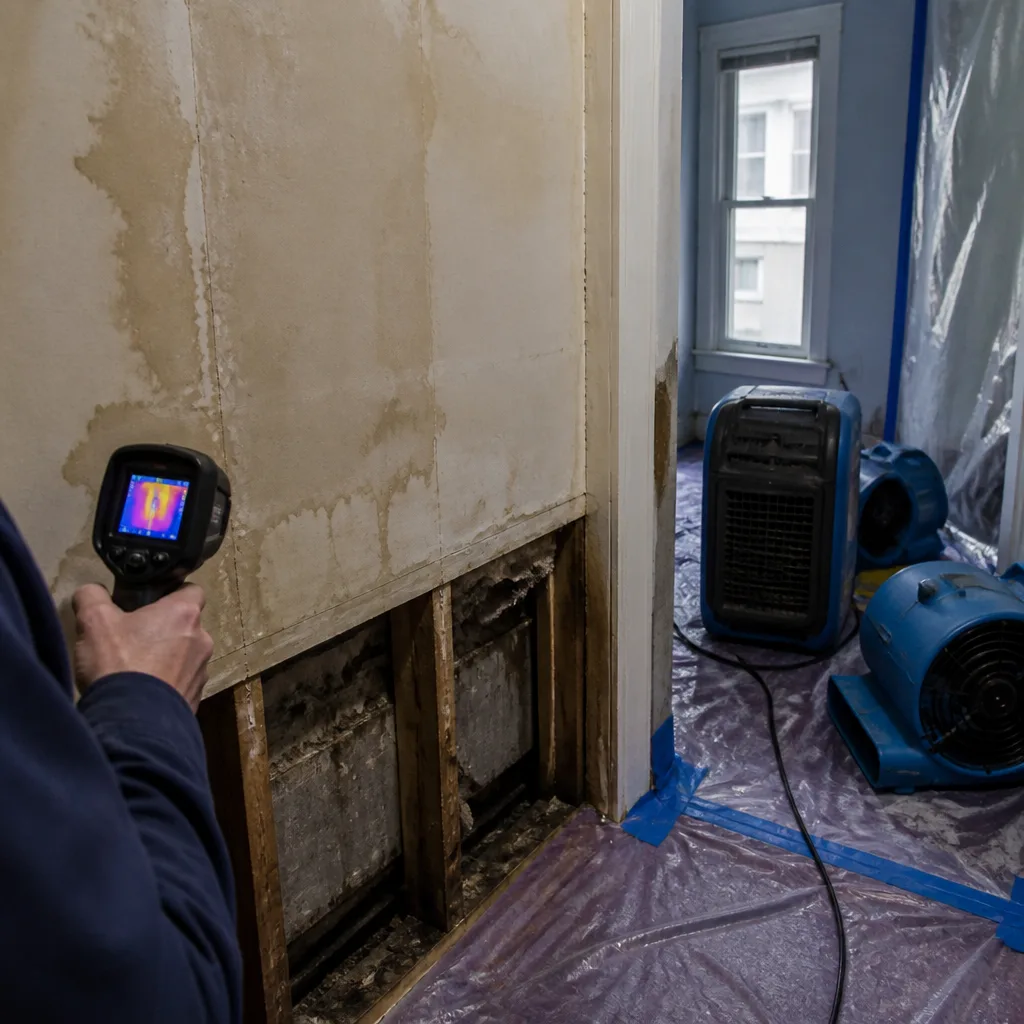
The math is brutal: $200 of rental equipment and a weekend of effort becomes a $12,000 to $17,000 problem. We’ve seen this exact sequence in apartments from Battery Park City to the Lower East Side. The moisture that matters isn’t on the surface; it’s inside the wall cavity, under the floorboards, behind the baseboard. Without a moisture meter and daily readings, you literally cannot know if you’ve dried it properly. Wade takes moisture readings every single day and hands the homeowner the full log at the end of the job. Almost nobody in the trade does this. It’s not because they’re hiding something; it’s because most companies don’t want the accountability that comes with a document trail. Wade grew up in this business believing the opposite: the log is the proof that the job was done right, and if the mold comes back, the log is what protects you.
Equipment Reality: What DIY Drying Actually Requires in a Lower Manhattan Apartment
Let’s be direct about the equipment. A household fan and a $40 dehumidifier from the hardware store will not dry out a water-damaged apartment in Lower Manhattan. They’ll move air around, but they won’t create the low-humidity, high-airflow environment required to pull moisture out of building materials. Professional water mitigation uses equipment built for this exact job.
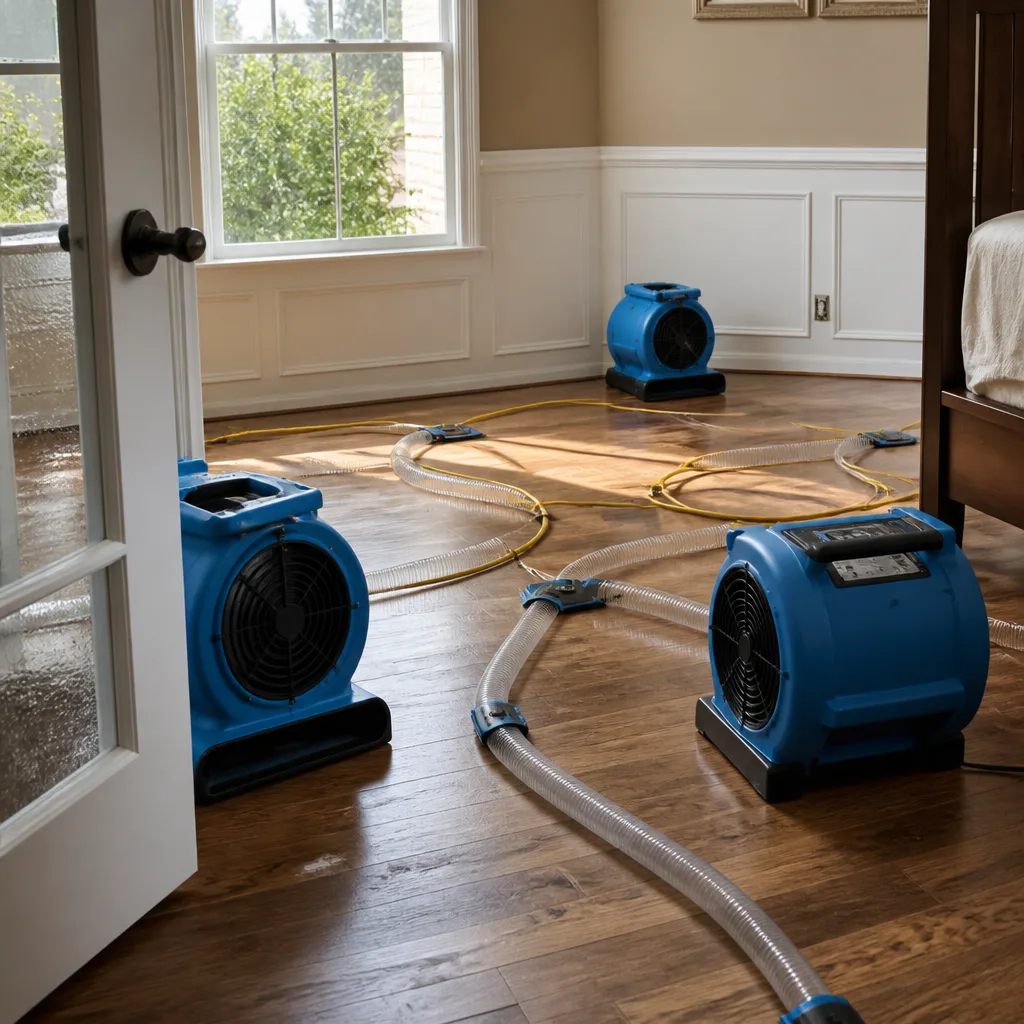
- Dri-Eaz and Phoenix air movers move 2,500 to 3,500 cubic feet of air per minute. A box fan moves maybe 1,000 CFM. The professional units are designed to create a vortex of air across wet surfaces that drives evaporation.
- Commercial dehumidifiers pull 30 to 130 pints of water per day. Your household unit pulls maybe 20 pints on a good day. The big units also run continuously without icing up or shutting off, which is what household units do after a few hours.
- Injectidry systems force air into wall cavities and under cabinets through small holes, drying spaces that would otherwise hold moisture for months.
- Moisture meters tell you when the materials are actually dry, not when they feel dry. Wood is considered dry at 6-12% moisture content. A water-damaged hardwood floor might read 25-30% for weeks after the surface feels bone dry.
Could a homeowner rent this equipment? Some of it, yes. Rental shops in the city carry air movers and commercial dehumidifiers. But knowing where to place them, how many to use, and when to pull them is the hard part. And in a Lower Manhattan apartment building, running commercial-grade equipment raises noise and electrical-load issues that neighbors and building management will notice. We’ve had building supers call us about tenants running rented dehumidifiers that tripped hallway breakers or kept the whole floor up at night. The professional route includes managing those logistics. Wade’s crew uses XPOWER and B-Air equipment alongside Dri-Eaz and Phoenix units, sized correctly for the space and placed to dry without creating a circus in the hallway.
Fire and Smoke Damage: Where DIY Attempts Go Wrong Fast
Fire damage restoration is its own animal, and here’s the part most people get wrong: the smoke does more long-term damage than the fire. Even a small kitchen fire in a Lower Manhattan apartment sends soot and smoke particles into every porous surface in the unit. Curtains, clothing, upholstery, drywall, ceiling paint, even the inside of your HVAC ducts. Soot is acidic. It etches metal, stains paint, and corrodes electronics. The longer it sits, the deeper it sets.
DIY fire cleanup usually means scrubbing walls with a sponge and repainting. That fails because soot has already penetrated the drywall, and paint won’t seal it. Within weeks, the yellow-brown stains bleed back through the fresh paint. Thermal fogging, ozone treatment, and HEPA air scrubbing are the tools that actually remove smoke odor and soot residue. None of those are homeowner tools. A professional fire and smoke damage restoration in Lower Manhattan company also handles the contents cleaning, the duct cleaning, and the structural assessment, all of which your insurance policy likely covers if done by a licensed contractor and documented properly.
One more thing: fire damage often involves water too, because the sprinkler system or the fire department’s hoses soaked everything. So you’re dealing with fire cleanup on top of water mitigation on top of smoke odor removal, all in a building where your neighbors are waiting for you to make it right. This is the furthest thing from DIY territory there is. Call Wade. He’s dealt with this in buildings from the Financial District to the South Street Seaport, and he’ll tell you straight what needs to happen.
When Wade Will Tell You to Handle It Yourself
Here’s the part that surprises people. Wade will talk you out of hiring him. If you call with a small, clean-water spill in one room, no drywall involvement, no flooring damage, and you caught it within an hour, he’ll tell you what to do: mop up the water, set up fans, keep the windows open, and call him back if the musty smell lingers or the baseboards start to darken. No charge for that. It’s not a sales tactic. It’s what an honest neighbor does.
He’ll also tell you when a second opinion is smarter than a new contract. If another company has quoted you $12,000 for a job that sounds like $4,000 of actual work, Wade will come out and look. His standing offer: free second opinion on any written estimate. He’ll sit down with you, go line by line through the other company’s scope, and tell you what’s necessary and what’s fluff. About half the time, he says the original estimate is fair and you should proceed. The other half, he saves people thousands. That’s the whole business model: be the guy whose name is on the truck, publish his address, and let the neighborhood hold him accountable. To wade is what you do through a flooded basement at two in the morning, and it happens to be his name. He’s been Wade’s Restoration home since 2007, and he’s not going anywhere.
Common Mistakes to Avoid
- Waiting too long to call anyone. In Lower Manhattan, humidity and building density mean mold can start in 48 hours. Every day of delay doubles the cost curve. If you’re not sure whether it’s serious, call Wade. He’ll tell you honestly over the phone whether he needs to come out.
- Demolishing before documenting. The adjuster needs photos of wet materials in place. Tear out the drywall first, and you’ve just thrown away your claim evidence. Photograph everything first, then act.
- Ignoring the co-op or condo board. In Lower Manhattan, almost every restoration job touches a common element: a riser pipe, a waste line, a structural wall, a shared floor/ceiling assembly. Your board has rules about who can do work and what insurance they need to carry. Ignoring those rules can cost you your proprietary lease.
- Using the wrong equipment. Household fans and small dehumidifiers move air but don’t dry building materials. You’ll get a false sense of dryness while moisture festers inside the walls. Six months later, mold.
- Mixing water and electricity. We’ve seen homeowners run power strips across wet floors to run fans and dehumidifiers. It’s not worth it. Kill the power first, or call someone who knows how to work safe around water.
- Assuming insurance will cover the DIY fix. Most policies have language about “reasonable and necessary” mitigation performed by “qualified professionals.” If you do it yourself and it goes wrong, the secondary damage may be excluded. Professional documentation protects the claim.
- Calling a national chain because their ad came up first. Wade has been called in to fix jobs that started with a national outfit’s phone quote and ended with a shocked homeowner staring at a bill twice the original number. Locally owned and owner-operated means Wade’s name is on the line every single time. Ask anyone on your street.
When to Call a Professional
You need a professional when the water is anything other than clean and caught immediately; when drywall, flooring, or wall cavities are involved; when the damage touches a neighboring unit; when mold is visible or the musty smell persists; when sewage has backed up; when fire or smoke has affected the unit; when your insurance company requires licensed contractors for mitigation work; or when you simply don’t want to spend the next three weekends fighting a dehumidifier in your own living room. Wade’s Restoration offers free estimates in Lower Manhattan. Call (607) 350-1550 and talk to Wade directly. He’ll give you an honest read on the situation, and if you don’t need him, he’ll tell you that too.
Frequently Asked Questions
Wade answers his own phone, and he can typically have extraction equipment running inside the hour for emergencies in Lower Manhattan. He’s on the road himself, not scheduling through a call center. When you call (607) 350-1550, you’re talking to the guy who shows up.
Most homeowners and condo policies cover sudden and accidental water damage from burst pipes or appliance failures when mitigation is performed by qualified professionals and properly documented. The key is acting fast and documenting everything. Wade deals with the insurance adjuster directly, which means you’re not stuck relaying information between two sides. Call (607) 350-1550 and he’ll walk you through what your policy likely covers.
It depends on the water category and how long the water sat. Clean water caught within 24 hours on non-porous surfaces might only need cleaning. Gray or black water, or any water that penetrated drywall or flooring, needs genuine remediation. Wade won’t oversell you. He’ll tell you if a cleaning crew is all you need, and he won’t charge for that advice.
Most co-op boards require that any contractor working in the building carry liability insurance, often with the building named as an additional insured. Some require board approval before demolition work begins. Rental tenants may need landlord permission before any work is done. Wade’s Restoration carries proper insurance and handles the paperwork; he’s worked in co-ops and condos throughout Lower Manhattan and knows what boards expect.
Moderate water mitigation for a pipe break typically costs $3,000 to $6,000 in Lower Manhattan, with repairs adding $5,000 to $10,000 depending on the scope. Mold remediation runs $4,000 to $12,000. Sewage cleanup costs more because of the contamination protocols. For an exact number, call Wade at (607) 350-1550. Estimates are free.
Yes, if it’s clean water, the area is under about 10 square feet, no drywall or flooring is involved, and you can fully dry it within 48 hours. Photograph everything first, keep receipts for any equipment you rent, and if anything looks off later, document it and call your insurer immediately. When in doubt, call Wade. The first call is free.
The Bottom Line
In Lower Manhattan, the DIY decision isn’t just about skill. Your lease, your co-op bylaws, and your insurance policy all have something to say about what you’re allowed to do when water invades your home. Small, clean spills handled fast are fine to tackle yourself. Everything else, from gray water to sewage to smoke damage, belongs with a professional who knows the buildings, the boards, and the claims process. Wade’s Restoration has been serving Lower Manhattan since 2007, and every job comes with the 90-Day Done Right Promise in writing. If it’s not done right, he makes it right. Call (607) 350-1550 and talk to a real person who will tell you the truth, even when the truth is that you don’t need him. For more guides & resources, visit our blog.
Written by Wade Ferris, Owner at Wade’s Restoration, serving Lower Manhattan since 2007.