
Quick Summary
When pipe bursts, steam riser leaks, or municipal infrastructure surges strike Midtown West properties, immediate emergency water damage restoration in Midtown West is crucial to prevent rapid vertical and horizontal moisture spread across multi-story buildings. Wade's Restoration provides specialized rapid-response mitigation tailored to Manhattan high-rises and prewar co-ops, deploying portable extraction, structural cavity drying, and controlled in-place restoration while navigating complex building logistics. Readers will learn critical initial mitigation steps, understand insurance and building coordination protocols, and can call 24/7 for immediate emergency dispatch and a free visual inspection with a written scope of work.
Emergency Water Damage Restoration in Midtown West
When clean water supply lines fail, steam risers leak, or sewage backs up in a Midtown West property, minutes matter. According to Wade’s Restoration, water damage restoration for high-rise condominiums, prewar co-ops, and commercial facilities involves water extraction, structural drying, and property stabilization.[5]
Water intrusion behaves differently in Manhattan than in standard suburban homes. Between multi-story riser stacks, shared plaster demising walls, and dense subflooring, moisture spreads vertically and horizontally before pooling on surface materials. NYC municipal reports confirm that water-main breaks can cause severe area flooding, property damage, and disruption of water service to connected properties. In fiscal year 2025, the New York City Comptroller reported 552 water-main breaks across the city, up from 359 in fiscal year 2024. While municipal records track breaks across Manhattan and the city as a whole rather than isolating a specific dataset for Midtown West, infrastructure pressure frequently impacts neighborhood basements and service connections.[1] See also Water Damage Restoration in Lower Manhattan | Call Now-10% Off | Same-Day Service | Free Estimate.
Emergency Response for Midtown West Properties
Prompt drying is recommended to reduce the risk of mold and further material damage. Actual arrival time depends on incident severity, crew availability, traffic, building access, and whether the water source has been stopped.
Restoration work in multi-unit buildings generally requires coordination with property managers, building superintendents, and co-op or condo boards to facilitate building access, service elevator usage, and compliance with property rules.
How Quickly Can Emergency Water Extraction Crews Respond to Midtown West Properties?
Actual arrival time depends on incident severity, crew availability, traffic, building access, and whether the water source has been stopped.
Navigating High-Rise Logistics and Service Elevator Access
As noted by Wade’s Restoration, high-rise and prewar buildings require logistical coordination. Coordinating with doormen or building superintendents helps secure service elevator access, identify water isolation valves, and stage equipment without blocking building egress corridors.
While awaiting restoration crews, property owners and occupants can take the following general safety and mitigation steps if safe to do so:
- Shut off the water source: Close the main unit shutoff valve or local fixture isolation valves under sinks and behind toilets to halt incoming water.
- Isolate electrical power: Switch off circuit breakers supplying affected rooms from a completely dry location. Never walk into standing water or touch electrical panels in damp areas.
- Protect valuable furnishings: Move small furniture, rugs, electronics, and drapes off wet flooring, or place aluminum foil under furniture legs to prevent staining.
- Notify building management: Alert your building superintendent or property manager so they can monitor neighboring units and assist with service access.
Municipal Surges and Infrastructure Failures
Aging city infrastructure places heavy demands on building systems. According to data from the New York City Department of Environmental Protection (DEP), water service was restored after confirmed water-main breaks in an average of 3 hours and 47 minutes during 2024. Extraction equipment is used to remove standing water resulting from plumbing and infrastructure failures.[2]
What Does Emergency Water Damage Restoration Cost in Midtown West?
Need emergency water damage restoration in Midtown West?
We’re available now - call for a fast, free estimate.
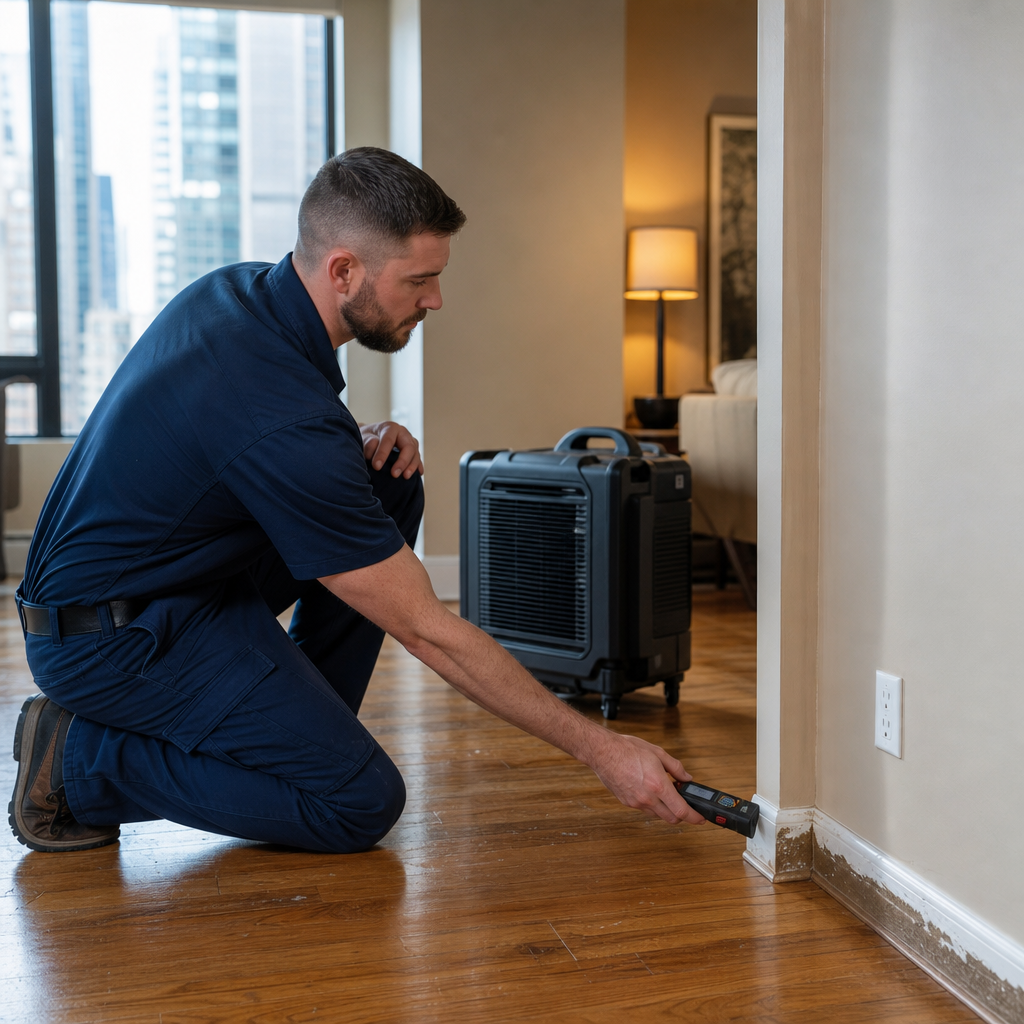
According to Wade’s Restoration, because every water incident involves different square footage, contamination categories, and structural materials, costs vary across Midtown Manhattan properties. Clean water supply line leaks addressed immediately typically incur lower restoration costs than sustained multi-floor leaks that have saturated building materials over extended periods.
Primary Cost Factors for Mitigation Projects
The total cost of emergency water restoration depends on several structural and environmental variables:[4]
| Service Component | Key Cost Determinants |
|---|---|
| Emergency Water Extraction | Volume and depth of standing water, accessibility, and high-rise versus sub-grade location |
| Cavity Drying and Dehumidification | Equipment requirements, air mover quantities, and total drying duration |
| Contaminated Water Cleanup | Category of water contamination, safety requirements, and sanitation procedures |
| Moisture Monitoring | Diagnostic scope, moisture assessment, and clearance documentation |
| Structural Repairs and Finishing | Extent of required drywall, plaster, flooring, or trim repair |
Navigating Co-op, Condo, and Commercial Insurance Claims
Coverage depends on the cause of the damage and the policy. Standard homeowners and tenants policies generally exclude flood damage, while separate flood coverage or endorsements may cover certain flood, sewer-backup, or related losses. Commercial policies require policy-specific review. Policyholders should contact their insurance carrier directly, thoroughly document all damage with photographs and notes, and retain all receipts and records related to mitigation and repairs.
Can High-Rise Hardwood Floors and Plaster Ceilings Be Restored Without Demolition?
Depending on the extent of water penetration, the category of water, and material conditions, specialized drying techniques may allow certain structural materials and assemblies to be dried in place, while heavily saturated or contaminated materials may require removal.
Drying in Place vs. Removal
Restoration approaches depend on building construction, material condition, and moisture levels.
| Project Factor | Controlled In-Place Drying | Structural Removal | Unmonitored Air Drying |
|---|---|---|---|
| Building Coordination | Requires coordination with building management and access rules | May require permits, alteration agreements, and neighbor notifications | Requires no external access, but does not address trapped moisture |
| Material Impact | Aims to dry salvageable materials in place where conditions allow | Involves removal and replacement of unsalvageable materials | Carries high risk of material degradation and ongoing moisture damage |
| Environmental Controls | Utilizes targeted drying and moisture containment | Requires debris containment and dust management | Risks spreading unmanaged moisture to adjacent assemblies |
| Project Scope | Focused on monitored drying until moisture standards are met | Involves demolition followed by reconstruction phases | Leaves hidden moisture pockets unaddressed |
Plaster and Wall Cavity Moisture
As technicians at Wade’s Restoration observe, when water travels down vertical pipe chases, it can collect inside wall cavities. Monitored airflow and structural dehumidification are used to dry wall framing and cavities to acceptable moisture levels before final repairs are completed.
Frequently Asked Questions About Midtown West Water Damage
How quickly can a restoration crew arrive at my Midtown West building?
A specific Midtown West arrival time cannot be verified. Actual arrival time depends on incident severity, crew availability, traffic, building access, and whether the water source has been stopped.
Will my insurance policy cover water damage restoration?
Coverage depends on the cause of the damage and the policy. Standard homeowners and tenants policies generally exclude flood damage, while separate flood coverage or endorsements may cover certain flood, sewer-backup, or related losses. Commercial policies require policy-specific review. Property owners should contact their insurance carrier, document all damage thoroughly, and retain all receipts.
How is water extraction handled in high-rises and commercial properties?
As explained by Wade’s Restoration, high-rise and commercial water extraction utilizes portable and specialized extraction equipment designed to operate within multi-story facilities where street-level vehicle access is restricted.
How is mold risk managed after a water leak?
According to general guidance from the EPA and FEMA, prompt drying is recommended to reduce the risk of mold and further material damage. Controlling moisture, drying clean materials within 24 to 48 hours, cleaning hard surfaces, and removing unsalvageable porous items that have absorbed contaminated water are standard practices to prevent mold growth.
What should I do right now while waiting for a restoration team?
If it is safe to do so, shut off the main water valve to stop active water flow, turn off electrical breakers to wet rooms from a dry area, elevate valuable items off wet surfaces, notify building management, and contact your insurance provider.[3]
Need emergency water damage restoration in Midtown West?
We’re available now - call for a fast, free estimate.
Sources
- Fiscal Year 2024 – CO-CONSULTING ENGINEERING … – nyc.gov (2028)
- DEPARTMENT OF ENVIRONMENTAL – nyc.gov (2015)
- Eric Adams – nyc.gov (2021)
- Audit of the New York City Department of Environmental … – comptroller.nyc.gov (2022)
- water-service-disruptions – NYC.gov – nyc.gov
Related reading: Emergency Water Damage Restoration in Midtown Manhattan – Call Now-10% Off – On-Site in 60 Minutes – Free Estimate
Related reading: Water Damage Restoration in Hoboken – 10% Off & Free Estimate – Same-Day Service
Related reading: Water Damage Restoration in Astoria – 10% Off & Free Estimate – Same-Day Service
Emergency Water Damage Restoration in Nearby Cities
We also serve the communities around Midtown West:
- Emergency Water Damage Restoration in Lower Manhattan
- Emergency Water Damage Restoration in Astoria
- Emergency Water Damage Restoration in Financial District
- Emergency Water Damage Restoration in Glendale
- Emergency Water Damage Restoration in Hoboken
- Emergency Water Damage Restoration in Jersey City
- Emergency Water Damage Restoration in Long Island City
Frequently Asked Questions
How does Wade's Restoration handle multi-floor water travel through prewar plaster walls and pipe chases?
Wade's Restoration utilizes specialized structural cavity drying systems and diagnostic moisture mapping designed specifically for Manhattan prewar construction. This targeted approach allows technicians to thoroughly dry dense subfloors and vertical wall assemblies in place, preventing trapped moisture without unnecessary demolition.
How does the team navigate Midtown West co-op board rules and building access during an emergency?
Wade's Restoration coordinates directly with building superintendents, property managers, and doormen to secure service elevator access and adhere strictly to building work protocols. Our crew deploys high-capacity portable extraction equipment tailored for multi-story residential settings to avoid obstructing common corridors.
Does Wade's Restoration provide reconstruction services after emergency water extraction is complete?
Yes, Wade's Restoration delivers end-to-end service covering initial emergency water extraction, structural dehumidification, and complete reconstruction of damaged drywall, plaster, and flooring. You can call our 24/7 live dispatch anytime to request an immediate response and a free visual inspection with a written scope of work.
About the author
 |
Christopher Vance Christopher Vance brings over 12 years of hands-on experience in emergency property restoration to his writing. Holding an IICRC certification in Water Damage Restoration and a degree in Environmental Science from Rutgers University, he specializes in creating actionable, expert guides for property owners facing critical damage. His work focuses on providing clear, practical advice to help Lower Manhattan residents navigate the complexities of water and flood recovery. |
Water damage, flood, or mold emergency?
We’re available now - call for a fast, free estimate.
Call Now - Free Estimate