
Quick Summary
When vertical risers or commercial sprinkler heads fail in high-rise towers and prewar buildings, fast emergency water damage restoration in Midtown Manhattan is essential to contain multi-floor structural flooding. Wade's Restoration provides end-to-end emergency mitigation with 24/7 live answering, a 45-minute dispatch time, and comprehensive capabilities spanning rapid extraction, in-place drying, and complete reconstruction. Property managers and owners can call Wade's Restoration immediately for 24/7 emergency dispatch to secure a free visual inspection and an itemized written scope of work for insurance claims.
Emergency Water Damage Restoration in Midtown Manhattan: What to Know
When a vertical riser fails on an upper floor of a high-rise or a commercial sprinkler head breaks in an office suite, water does not stay confined to one room. It follows gravity down through electrical conduits, concrete floor slabs, and shared walls into the units below. Addressing emergency water damage restoration in Midtown Manhattan involves mitigating that downward cascade to limit property damage. From historic prewar buildings near Murray Hill to commercial towers along Sixth Avenue, effective recovery requires rapid containment, moisture assessment, and compliance with individual building access guidelines.
In general restoration-industry practice, technicians from teams like Wade’s Restoration utilize moisture detection tools, commercial extraction equipment, and dehumidifiers to locate trapped water and dry affected areas while aiming to minimize structural demolition.[3] See also Water Damage Restoration in Lower Manhattan | Call Now-10% Off | Same-Day Service | Free Estimate.
Quick answer
Quick answer in brief: Emergency water damage restoration in Midtown Manhattan generally focuses on water removal, structural drying, and moisture tracking. In urban multi-story buildings, property managers and restoration contractors typically need to navigate building access, elevator logistics, and property-specific requirements. While some providers may offer emergency services, availability must be confirmed directly, and response times vary based on location, traffic, and access conditions.
Rapid mitigation helps protect structural integrity and salvage materials. According to the New York City Department of City Planning, Manhattan accounts for the highest average National Flood Insurance Program (NFIP) claim payouts among the five boroughs, despite having fewer total claims boroughwide. While this reflects borough-level data rather than Midtown-specific statistics, it demonstrates the financial impact of water incidents in dense urban environments. In general restoration practice, technicians such as those at Wade’s Restoration map moisture and provide itemized documentation for insurance claims.[5]
What Does Emergency Water Damage Restoration Cost in Midtown Manhattan?
The cost of restoring water damage depends on several practical factors: the category of water (clean supply line, gray wash water, or black sewage), the total square footage affected, how long the moisture has lingered, and the extent of structural drying required. Because every building layout and plumbing failure is different, property owners should request a clear, written scope of work based on an in-person assessment.
Key Factors Driving Commercial and Residential Restoration Costs
Operating in Midtown Manhattan involves specific logistical realities that influence overall restoration pricing:
- Building Access and Elevator Logistics: Multi-story and high-rise properties often require advance freight elevator reservations, dedicated security clearances, and protection for shared hallways.
- Preservation vs. Demolition: In standard industry practice, drying architectural materials in place using commercial drying equipment can reduce rebuilding costs, though feasibility depends on the extent of damage and material composition.
- Water Contamination Levels: Clean water from a ruptured supply line requires straightforward extraction and drying, whereas sewage backups or contaminated floodwater require antimicrobial sanitation and containment procedures.
Subgrade infrastructure challenges also contribute to water risks across the city. According to the New York City Comptroller’s Office, an estimated 23,200 basements and cellars citywide (approximately 5.5% of the citywide total) are in areas vulnerable to flooding during moderate-rainfall events. While this is a citywide figure rather than a documented Midtown-specific finding, subgrade spaces across the borough face potential risks from heavy stormwater.[1]
How Do Restoration Teams Handle High-Rise Co-ops and Historic Buildings?
Need emergency water damage restoration in Midtown Manhattan?
We’re available now - call for a fast, free estimate.
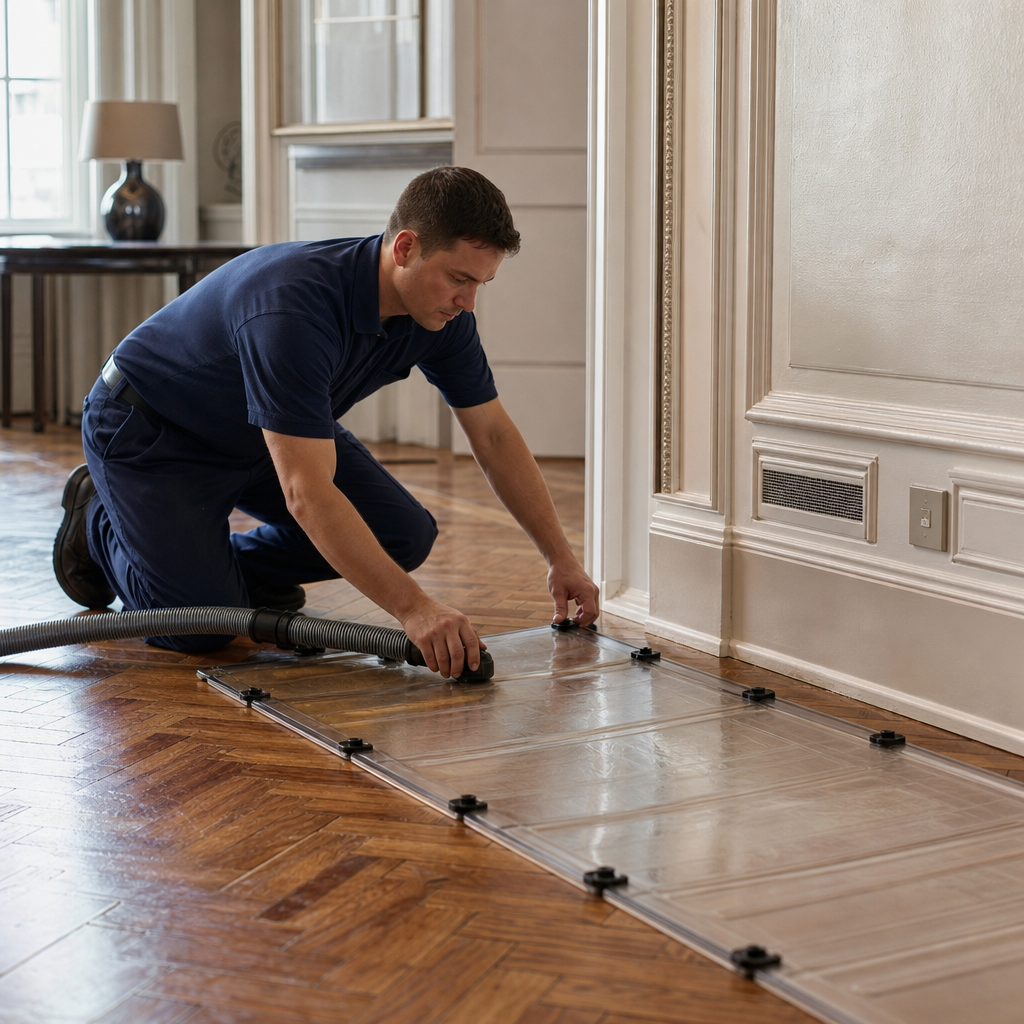
Restoring a high-rise co-op or a prewar commercial property requires balancing moisture removal with building regulations. General restoration standards emphasize stabilizing the environment and drying materials in place whenever feasible.
Mitigating Vertical Water Cascades Across Multiple Floors
When an upper-floor pipe bursts, water can travel downward along building utility channels. In general industry practice, addressing multi-floor water intrusion involves:
- Building Management Coordination: Securing necessary approvals and providing required documentation, such as Certificates of Insurance naming property management, to meet building entry guidelines.
- Multi-Floor Extraction: Setting up extraction units across affected levels to stop water from continuing down through chases and fixtures.
- Cavity and Structural Drying: Applying commercial dehumidifiers and air movers according to restoration standards to dry enclosed spaces.
According to the New York City Department of City Planning, approximately 25,300 basements and cellars across New York City sit within the current 100-year floodplain. While high-rise units primarily face pipe and riser failures from above, subgrade and street-level spaces face general possibilities of stormwater intrusion or sewer backups during severe rain events.[2]
Midtown Case Study: Saint Peter’s Church Water-Main Break
According to public reports and church recovery documentation, a January 4, 2021 water-main break near Lexington Avenue and 53rd Street flooded Saint Peter’s Church. The incident led to phased mitigation and rebuilding, including standing-water and mud removal, flood cuts, structural evaluation, and later wall remediation.
Preserving Architectural Materials
Historic and prewar buildings often feature original plaster and hardwood flooring. In general restoration practice, technicians such as the team at Wade’s Restoration evaluate whether materials can be dried in place using specialized drying equipment or if selective removal is required based on moisture readings and sanitary conditions.
What Immediate Steps Should You Take While Waiting for Emergency Crews?
Taking prompt precautions during a water leak can help reduce property damage and protect personal safety.
Immediate Safety and Water Isolation Checklist
- Assess Immediate Danger: Leave the premises and call 911 immediately if there is any threat to safety or signs of structural collapse.
- Avoid Electrical Hazards: Avoid flooded rooms and live wires. Do not restore power until a licensed electrician confirms safety.
- Stop the Water Source: If it is safe to do so, shut off the local fixture valve or main water line. Contact the building superintendent or engineer if the valve is inaccessible.
- Isolate Contaminated Water: Keep people and pets away from standing sewage or contaminated water.
- Document the Damage: Take photographs and video footage of standing water, damaged structures, and affected contents.
Insurance Considerations and Claim Steps
As recommended by Wade’s Restoration, property owners should notify insurers promptly, document damage thoroughly, and limit work to emergency measures needed to prevent further damage until claim procedures are confirmed.
Insurance coverage depends on the specific policy terms and the cause of the damage. Standard homeowners policies generally exclude flood damage. Sewer-backup or sump-pump losses may require an endorsement, and separate NFIP flood insurance may cover qualifying losses for homeowners, renters, and businesses. According to the New York City Department of City Planning, over 400,000 residents live within the citywide 100-year floodplain, highlighting the importance of verifying policy coverage before an incident occurs.[4]
Frequently Asked Questions About Midtown Manhattan Water Damage
As noted by Wade’s Restoration, managing water incidents in Midtown requires prompt mitigation, adherence to building protocols, and proper documentation.
How fast can crews arrive for emergency water extraction?
Arrival time depends on provider availability, traffic, building access, elevator restrictions, and incident severity. No reliable neutral source establishes a guaranteed Midtown arrival time.
Does insurance cover commercial water damage cleanup in Midtown NYC?
Coverage depends on the specific policy and the cause of the loss. Standard commercial and homeowners policies generally cover sudden and accidental internal plumbing failures, but standard homeowners policies generally exclude flood damage. Losses from sewer backups or sump-pump failures may require a specific endorsement. Separate NFIP flood insurance may cover qualifying flood losses for homeowners, renters, and businesses. Policyholders should review their terms with their insurance representative.
How much does full-service emergency restoration cost?
Total costs depend on the water source, contamination category, square footage, and whether materials can be dried in place or require replacement. Property owners should obtain a written scope of work based on an on-site evaluation before major restoration proceeds.
Need emergency water damage restoration in Midtown Manhattan?
We’re available now - call for a fast, free estimate.
Sources
- Reducing the Effects of Urban Flooding in New York City – fema.gov (2023)
- Building Performance: Egress from Floodprone Basements – fema.gov (2022)
- Bringing Basement Apartments Into the Light – Office of the New … – comptroller.nyc.gov
- CDBG-DR – nyc.gov
- NYC's Floodplain by the Numbers – nyc.gov
Related reading: Emergency Water Damage Restoration in Long Island City – Call Now-10% Off – On-Site in 60 Minutes – Free Estimate
Related reading: Water Damage Restoration in Hoboken – 10% Off & Free Estimate – Same-Day Service
Related reading: Water Damage Restoration in Astoria – 10% Off & Free Estimate – Same-Day Service
Emergency Water Damage Restoration in Nearby Cities
We also serve the communities around Midtown Manhattan:
- Emergency Water Damage Restoration in Lower Manhattan
- Emergency Water Damage Restoration in Astoria
- Emergency Water Damage Restoration in Financial District
- Emergency Water Damage Restoration in Glendale
- Emergency Water Damage Restoration in Hoboken
- Emergency Water Damage Restoration in Jersey City
Frequently Asked Questions
How do emergency restoration teams handle building access and COI requirements in Midtown high-rises?
Professional restoration teams coordinate directly with property management and building engineers to provide compliant Certificates of Insurance (COIs) and secure freight elevator access. Wade's Restoration regularly navigates strict Midtown co-op and commercial property rules to ensure rapid entry without procedural delays.
What happens after water extraction and structural drying are completed?
Once moisture mapping confirms all cavities and building materials are completely dry, the property transitions to structural repairs, antimicrobial treatments, and cosmetic rebuilding. Wade's Restoration manages the entire lifecycle end-to-end, taking high-rise units and historic spaces from emergency extraction through complete reconstruction.
How quickly can I receive an itemized scope of work for my insurance claim?
A written scope of work is generated directly following the on-site moisture mapping and damage evaluation. Wade's Restoration offers a free visual inspection and provides comprehensive, itemized claim documentation to help expedite approvals with your insurance carrier.
About the author
 |
Christopher Vance Christopher Vance brings over 12 years of hands-on experience in emergency property restoration to his writing. Holding an IICRC certification in Water Damage Restoration and a degree in Environmental Science from Rutgers University, he specializes in creating actionable, expert guides for property owners facing critical damage. His work focuses on providing clear, practical advice to help Lower Manhattan residents navigate the complexities of water and flood recovery. |
Water damage, flood, or mold emergency?
We’re available now - call for a fast, free estimate.
Call Now - Free Estimate