
Quick Summary
High-rise riser breaks and mechanical plumbing failures demand immediate, specialized water damage restoration in Midtown Manhattan to prevent multi-floor moisture migration through complex vertical utility chases and structural assemblies. As a premier rapid-response mitigation specialist, Wade's Restoration deploys advanced moisture mapping, commercial structural drying, and seamless reconstruction tailored to the rigorous logistical and COI demands of Manhattan properties. Property owners and managers can safeguard architectural finishes and prevent mold growth by calling Wade's Restoration on the 24/7 emergency dispatch line for immediate water extraction and a free visual inspection.
Water Damage Restoration in Midtown Manhattan – Rapid Recovery
When emergency water damage restoration in Midtown Manhattan is required, certified technicians can be dispatched promptly to the property. Professionals isolate active leaks, extract standing water, and stabilize the structure before moisture damages lower floors. Overall pricing reflects the water category, total square footage, affected structural materials, and required drying time. Whether a property faces a ruptured heating line in a prewar co-op or a burst riser in a modern tower, fast action helps save architectural finishes and prevent secondary mold growth.[4]
Manhattan properties face unique structural and geographic challenges. While Midtown Manhattan flood exposure should be checked at the property level using FEMA’s current flood maps, because flood zones can vary by address and are updated over time, internal mechanical failures cause most high-rise water losses. NYC provides local flood map resources that point users to FEMA for address lookup and flood hazard determination, and the FEMA National Flood Hazard Layer is available for New York to support specific location reviews. Local restoration crews like Wade’s Restoration handle every phase of recovery, from water extraction to structural repairs, coordinating with building management and insurance representatives.[1] See also Water Damage Restoration in Lower Manhattan | Call Now-10% Off | Same-Day Service | Free Estimate.
Quick Answer
Quick answer in brief: Professional water damage restoration in Midtown Manhattan requires rapid emergency dispatch to extract standing water, deploy drying equipment, and mitigate mold risks that can develop in damp environments within 24 to 48 hours. Certified technicians use moisture detection tools to track water moving through vertical utility chases, prewar plaster, and concrete subfloors. Restorers manage building management requirements, Certificates of Insurance (COIs), and detailed claims documentation to return properties to pre-loss condition.[2]
Midtown commercial and residential properties deal with complex vertical infrastructure. Standard surface cleaning often misses hidden moisture paths created by vertical riser leaks, where water from an upper-floor plumbing failure enters vertical utility chases and travels downward through floor assemblies into multiple units below.
Stabilizing a multi-story water loss follows three main steps:
- Source Control and Bulk Extraction: Shutting off building supply lines, isolating risers, and running extractors to stop water spread across occupied floors.
- Moisture Mapping: Tracing moisture migration through walls, mechanical chases, and concrete slabs using thermal imaging and moisture meters.
- Building Management and Insurance Coordination: Supplying required COIs to building management, arranging freight elevator access, and providing detailed documentation for insurance review.
What Does Water Damage Restoration Cost in Midtown Manhattan?
Need water damage restoration in Midtown Manhattan?
We’re available now - call for a fast, free estimate.
Water restoration costs in Midtown Manhattan depend on the source of the water (clean supply, gray water, or black water sewage), the building’s structural composition, the total square footage saturated, and the necessary drying time. Addressing water trapped inside multi-layer floor assemblies or behind commercial walls requires appropriate drying setups that influence the overall scope.[5]
Cost Factors Across Common Manhattan Loss Scenarios
Mitigation needs vary between single-room residential supply leaks and multi-floor commercial riser failures that saturate multiple tenancies.
| Loss Scenario | Primary Scope Requirements | Typical Drying Time | Equipment Deployed | Containment Protocols |
|---|---|---|---|---|
| Minor Supply Line Leak | Surface extraction, baseboard removal, targeted drying | 24 to 48 hours | Dehumidifiers, air movers | Localized room-level containment |
| Vertical Riser Rupture | Multi-floor water extraction, ceiling removal, structural drying | 3 to 5 days | Commercial dehumidification units, structural drying systems | Multi-floor vertical zone containment with dust barriers |
| Sewage Backup / Category 3 | Biohazard extraction, porous material removal, structural sanitization | 5 to 7 days | Air scrubbers, antimicrobial treatments, commercial dehumidifiers | Containment barriers with controlled access |
Variables Influencing Project Pricing in Midtown
Urban architecture creates specific logistical requirements. When a pressurized line breaks on an upper floor of a Midtown building, water can travel through plumbing chases and reach concrete floor slabs. Standard surface extraction may not dry enclosed structural cavities, requiring specialized drying techniques to minimize material removal.
High-rise logistics also affect overall mitigation costs. Restoration teams must supply building-specific Certificates of Insurance with required liability limits, coordinate freight elevator availability, adhere to building work-hour rules, and manage containment across affected floors. Restoration providers like Wade’s Restoration supply itemized documentation formatted for insurance adjusters to support the claims process.
Why Does High-Rise Water Damage in Midtown Require Specialized Structural Drying?
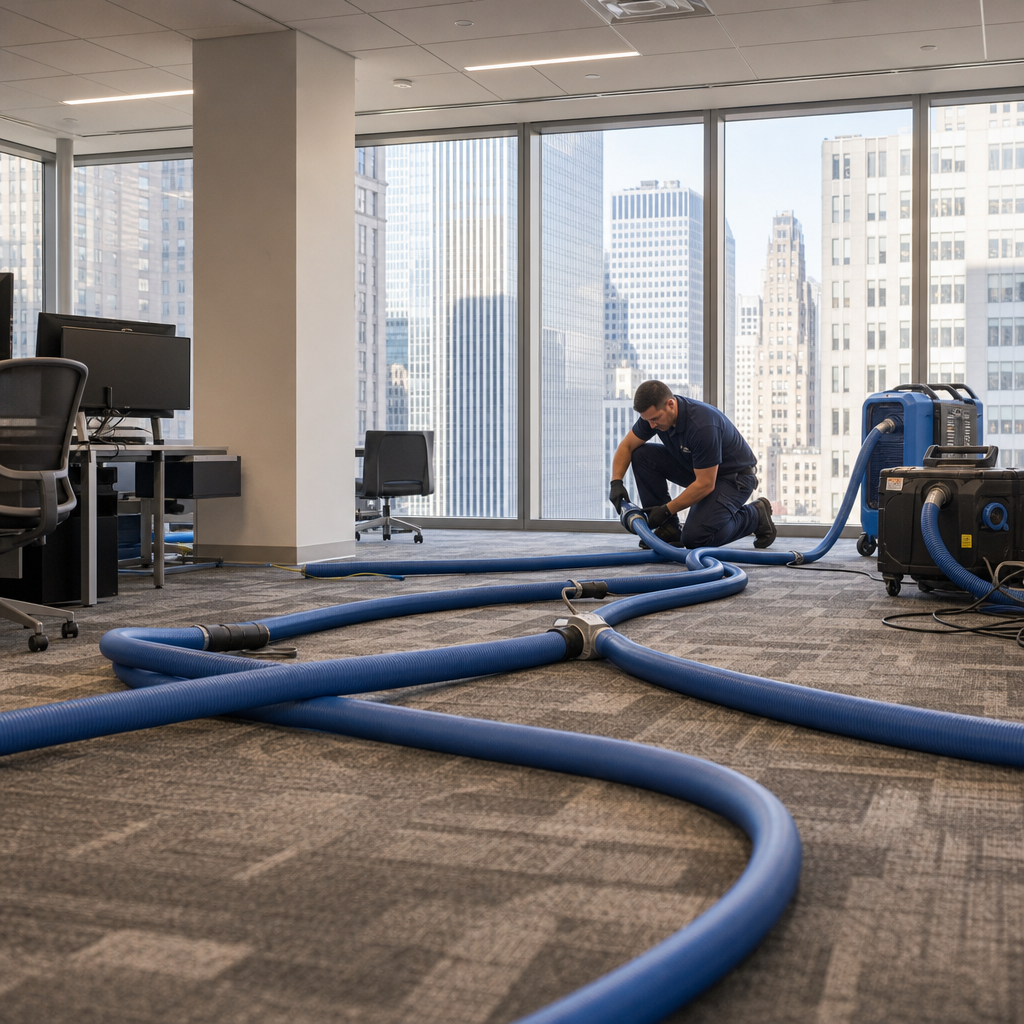
High-rise water losses in Midtown differ significantly from single-family residential leaks. Water follows gravity down electrical conduits, plumbing chases, and structural columns, pooling on concrete slabs and soaking through ceiling assemblies below. Surface extraction only removes standing water, leaving moisture trapped inside structural layers where it can lead to secondary damage and mold growth if not dried promptly.
The High-Rise Riser Impact in Prewar and Modern Towers
In older prewar buildings along Midtown East and West, water can penetrate porous masonry arches, terra cotta floor tiles, and plaster walls. In modern towers, water moves across concrete decks, entering perimeter wall tracks and drop ceilings. In both building styles, water can rapidly enter structural cavities.
To limit unnecessary demolition, restorers such as Wade’s Restoration can use targeted structural drying techniques. Commercial dehumidifiers and air movement systems direct dry air into affected cavities and structural assemblies, aiding the removal of moisture from concrete, masonry, and framing.
Preserving Hardwood Flooring and Architectural Finishes
Restoring hardwood floors, parquet, and custom millwork requires controlled drying to extract moisture and minimize material distortion.
| Building Material | Common Removal Method | Targeted Preservation Approach |
|---|---|---|
| Custom Hardwood & Parquet | Full floor removal down to subfloor | Specialized drying mat systems that extract moisture through flooring assemblies |
| Commercial Wall Assemblies | Extensive drywall removal across perimeter | Targeted cavity drying techniques using access points behind baseboards |
| Prewar Plaster & Lath | Complete stripping and drywall replacement | Controlled structural dehumidification to stabilize base coats and preserve historic materials |
What Are the Core Steps in Commercial and Residential Water Extraction?
Need water damage restoration in Midtown Manhattan?
We’re available now - call for a fast, free estimate.
A systematic recovery plan prevents structural weakening, mitigates microbial growth, and keeps multi-unit losses contained. The professional restoration process generally follows several diagnostic and operational phases.
1. Immediate Water Containment and Bulk Removal
Technicians assist in isolating the water source where necessary, establish containment to protect adjacent living and commercial spaces, and deploy commercial extraction units. In multi-story buildings, extraction equipment removes standing water from affected common areas, mechanical spaces, and corridors.
2. Diagnostic Moisture Mapping
Technicians use moisture meters and infrared thermal cameras to trace moisture paths across ceilings, behind baseboards, and through subfloors. This data establishes baseline readings and helps determine drying equipment layout.
3. Dehumidification and Antimicrobial Treatment
Crews install commercial dehumidification systems, position air movers to facilitate evaporation, and operate HEPA air scrubbers when air filtration is needed. Affected structural framing and concrete assemblies may receive appropriate EPA-registered antimicrobial applications to inhibit mold and bacterial growth.
How Does Insurance Coverage Work for NYC Apartment and Commercial Leaks?
Insurance coverage for water damage depends heavily on the specific policy terms and the underlying cause of the loss. In general, sudden and accidental internal water damage (such as a burst pipe or mechanical failure) is covered by standard property policies, whereas damage from external flooding is typically excluded unless covered under a separate flood insurance policy.[3]
Navigating Co-Op, Condo, and Commercial Policies
Responsibility and coverage boundaries depend on policy language and where the failure originated:
- Building Master Policy: Typically covers primary building infrastructure, structural concrete slabs, common hallways, and shared utility chases.
- Individual Unit Policies (HO-6 / Commercial Tenant): Generally cover interior finishes, custom millwork, flooring, cabinetry, and personal or business property.
- Commercial Leases: Allocate responsibility according to lease terms, distinguishing between base building systems and tenant-installed fixtures.
Insurance Claims Documentation Support
To assist the insurance adjuster’s review, professional restoration teams such as Wade’s Restoration compile standard claims documentation:
- Drying Logs: Daily temperature, relative humidity, and material moisture readings to record drying progress.
- Photographic and Thermal Reports: Photographic records documenting affected areas and moisture migration paths.
- Itemized Scopes: Standardized line-item estimates detailing equipment, labor, and mitigation procedures.
Frequently Asked Questions About Midtown Water Damage Cleanup
How quickly can a restoration crew arrive at a Midtown building?
Response times vary based on traffic, building check-in protocols, and location, but local emergency restoration teams typically offer rapid dispatch 24/7 across Midtown to stabilize water migration before secondary damage spreads to adjacent units.
Do restoration teams coordinate directly with building managers and co-op boards?
Yes. Restoration professionals routinely work with Midtown property managers, managing agents, and building superintendents. They supply required Certificates of Insurance, arrange freight elevator access, and ensure drying equipment setups meet building requirements.
How is mold growth prevented after an indoor pipe break?
Because mold can begin to develop on damp organic materials within 24 to 48 hours in moist conditions, technicians mitigate growth by rapidly extracting standing water, setting up commercial dehumidifiers and air movers to thoroughly dry structural materials, and applying antimicrobial agents where appropriate.
Can hardwood floors be saved after a significant water leak?
Yes, in many cases, provided drying begins promptly. By utilizing specialized hardwood drying mat systems that draw moisture out of the floor assembly, restorers like Wade’s Restoration can often salvage hardwood, parquet, and engineered flooring without requiring full replacement.
Need water damage restoration in Midtown Manhattan?
We’re available now - call for a fast, free estimate.
Sources
- FEMA Flood Map Service Center | Welcome! – msc.fema.gov
- Historical NFIP Claims Information and Trends – floodsmart.gov
- Find Your Flood Map – NYC.gov – nyc.gov
- FEMA Flood Map Service Center: Welcome! – msc.fema.gov
- Flood Hazard Mapper – NYC.gov – nyc.gov
Related reading: Water Damage Restoration in Long Island City | 10% Off & Free Estimate | Same-Day Service
Related reading: Water Damage Restoration in Hoboken – 10% Off & Free Estimate – Same-Day Service
Related reading: Water Damage Restoration in Astoria – 10% Off & Free Estimate – Same-Day Service
Frequently Asked Questions
How does Wade's Restoration handle the reconstruction phase after water extraction and structural drying are complete?
Wade's Restoration provides a seamless transition from emergency structural drying to complete architectural reconstruction. Our specialized teams repair damaged prewar plaster, replace commercial drywall assemblies, and restore custom hardwood or high-end millwork to pre-loss condition without requiring third-party rebuild contractors.
How quickly can Wade's Restoration issue a compliant Certificate of Insurance (COI) for Midtown high-rises?
Our emergency dispatch team generates building-specific, fully compliant COIs meeting exact liability limits within minutes of your call. This rapid turnaround allows our crews to clear security, secure freight elevator access, and deploy extraction equipment without administrative delays from co-op boards or commercial management.
What steps are taken if an upper-floor pipe break migrates moisture down into lower units?
Wade's Restoration immediately maps multi-floor moisture migration through vertical utility chases and concrete floor assemblies using calibrated thermal imaging and moisture meters. We coordinate directly with building superintendents and affected occupants to contain structural cavities, stop downward water spread, and generate unified insurance documentation.
About the author
 |
Christopher Vance Christopher Vance brings over 12 years of hands-on experience in emergency property restoration to his writing. Holding an IICRC certification in Water Damage Restoration and a degree in Environmental Science from Rutgers University, he specializes in creating actionable, expert guides for property owners facing critical damage. His work focuses on providing clear, practical advice to help Lower Manhattan residents navigate the complexities of water and flood recovery. |
Water damage, flood, or mold emergency?
We’re available now - call for a fast, free estimate.
Call Now - Free Estimate